Saturday, May 06, 2006


Santiago de Compostela-Lugo

Trip dist: 110 kms. Trip time:8 hrs, 46 mins. Tot distance: 838 kms.

Interactive Blog post #1.

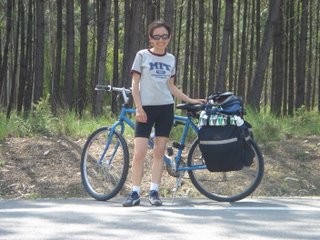
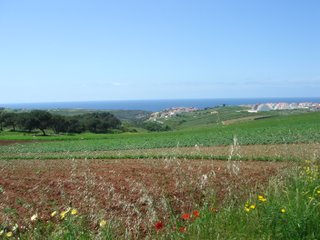
Aaaah, Galicia. What a beautiful countryside. The ride was marvelous, with landscape views among the most stunning I've ever seen (and that's already considering Italy and Switzerland!), very green, and....well, words don't suffice. I wonder if some Galician writer has bothered to put the land into words, it would be great to read them, since mine are, of course, quite inadequate to describe the sights. This was hands down one of the best bike rides I've ever done, a bit difficult due to the elevated number of uphills and corresponding windy and chilly super-fast downhills (top speed reached: 52kms hour coasting!), but well worth it (See some pictures here). To top it off, the arrival into Lugo was all downhill for the last 10 kms, you see Lugo as you reach the top of an incline, and all downhill from there. Exhilarating.

Another nice thing happened to me during the ride. At one point, while heading up one of the numerous hills, I started seeing traffic police on motorcicles heading my way from the opposite direction, sometimes signalling, sometimes lifting a hand in quick greeting, followed by an ambulance, and more police on cars. An accident behind me surely, I thought, though the traffic police seemed a bit too jovial for such an occasion. Eventually, I started seeing cars with two road bikes on the roof, several of them, people inside in cycling uniforms, who as soon as they saw me honked or lifted their hand in greeting, again, strange happenings, but I didn't really put two and two together.

Eventually, one of the traffic police as I approached a hillside village where a lot of traffic was stopped signalled to me about 200 meters before I reached the cars, so that I was still in the middle of the uphill undisturbed, to stop by the side of the road and very emphatically said to me: "Don't move."

Very puzzled at this, I dropped off the bike and stood there, not quite understanding. Five seconds later, here comes flying downhill a platoon of cyclists on a bycicle race! Must've been about 70 of them, some of them passing quite close to me, and the surprise and glee and good humour at seeing them was terrific. You remember how I said before how running into a handful of youngsters on their mountain bikes was a bit like finding dolphins following your boat at sea? Well, being surrounded by 70 multi-colored cyclists dashing down the hill at over 50 kms per hour was a little bit like being caught among a suddenly direction-changing school of sardines, so slick, elegant, colorful, and...shocking, even (I wish I had put two and two together with the cars so that I could've taken a video for you. But perhaps that would've ruined the effect of the shock and surprise, if I had known beforehand).

I told you it was a nice ride. :) Heh heh, and that includes the teasing I got from the villagers afterwards as I continued uphill once the racers had passed, who kept shouting at me: "It is the other way!"


Anyway, arrived in Lugo in good spirits, ready to explore this city, whose Roman Walls are a UNESCO World Heritage Site.

I'll be here for at least one more day, but afterwards, there is a slight bifurcation on the road: I could head northeast to Oviedo, another World Heritage City, arriving there after two days on the road, and then possibly daytrip to the prehistoric paintings of the caves of Altamira (another UNESCO World Heritage site), before heading southwards towards León and continuing on my way to Madrid, or, I could head directly southeast towards León, and daytrip from there to Oviedo, thus saving myself two days of biking, which could be better spent in cities like Madrid or Barcelona, but at the same time also missing Altamira. Additionally, it is unclear (for stupid Let's Go guide doesn't even mention Altamira), whether I can actually get to Altamira easily from Oviedo: I have no idea if there are busses to there or how long they would take if there are.

So, what does my readership think? Ever wanted to have a hand in controlling someone's destiny from afar? Ever wanted to do some experiments in long-distance mind control? Play the weaving of the fates? Well, now you have your chance to do so! Submit your vote in the comments section of this post, and weigh the dice of my future to your will! I will check here shortly before I head out of Lugo, and for a couple of days let you play God with my trajectory.


Friday, May 05, 2006


Santiago de Compostela, Day 2.

El Botafumeiro.

Random thought of the day: Tapestries. The first kind of digitized pictures.

Today I woke up to the bells of the Cathedral's Clock Tower, which were rung surprisingly softly and sweetly, as if with deliberate care, knowing that they would be the greetings to morning for the dwellers in the nearby plazas (I'm in a nice little hotel called "Hotel Libredon", for 27 Euros I get a charmingly small room with private bathroom, and I'm located right at the Plaza Fonseca, just half a block away from the Cathedral). After a nice breakfast of churros con chocolate (not quite as good as the ones in Mexico, I must say), I headed over to the Cathedral, and hung out during the Pilgrim's mass in order to try to catch the famous Botafumeiro.

The Botafumeiro is a huge, silver-plated, 50 kg censer, that is suspended off the rafters of the cathedral near the altar into a pendulum with a cord length of about 30 meters, and is swung in a majestic arc spanning the (sideways) length of the cathedral, tradition says, in order to purify the Pilgrims, in more of a literal sense than figurative, for obviously after such a long journey in medieval times, well, they tended to be dusty and dirty and smelly. Now, the men who operate this pendulum (see the movie by clicking on picture or following above link) are called tiraboleiros, and there are two documented instances of them ever losing control of the Botafumeiro: one, during the goodbye mass of Catherine of Aragon, shortly before she was to leave for England to wed Henry the VIIth, and of course, in hindsight, many people then claimed it had been a bad omen, you see what happened to her?, and the second, back in the 1700s sometime, when the Botafumeiro actually flew off the cord and went through the circular window you see in the movie, and ended up in Plaza de Platerias, next door. Cool huh? These medievals sure knew how to have fun!

Anyway, remember I told you that the Santiago de Compostela is famous because here is where they found the bones of the apostle James? Right, but, back in the age of no DNA testing or dental records, how did they know that the pile of bones that they found on the hill were indeed his and not someone else´s (say, a random Roman soldier, for instance, considering that the "discovery" was made back in 899 A.D. or so, and there were a bunch of Roman settlements--Iria Flavia, by the way, was one of them--around the area)? Well, says the legend, that after Santiago/James/Iacobus was beheaded by Herod in 44 A.D. and left without burial, his disciples picked up the body and embarked it on a ship that sailed from Jaffa, which supposedly, after seven days (it was a miraculously fast ship!), arrived in Iria Flavia. Now, Iria Flavia was governed by the Roman queen Lupa, and the disciples upon arrival went to the palace of Castro Lupario to ask her for a place to bury the apostle. She of course, sends them to one of the Roman authorities, who not wholly unexpectedly orders their imprisonment. They are later freed by an angel, and queen Lupa tries to trap them again by sending them to Mount Ilicine to search for oxen, which in reality were fierce bulls, to transport the apostle's body. But in another miracle, the bulls turn out to be tame and meek, after which the disciples bless the mountain and it becomes the Sacred Peak. Lupa then converts to Christianity and gives the area of Libredòn to the disciples, as a burial spot. Others claim that Santiago came to Spain for preaching. The reasons for this claim are also rather interesting: the kingdom of Asturias at around that time (VIIIth century) had its political reasons for associating itself with the apostle, in a move, I imagine, to aggrandize and glorify itself in a rather "nationalistic" pride kind of thing (this is common to a lot of nations/civilizations. Virgil, for instance, claimed in his Aeneid, that Aeneas, founder of Rome, was a Trojan hero, clearly, a more glorious and aggrandizing story than Rome being founded by two savage and wild wolf-boys Romulus and Remus). Then, it simply follows that given that he preached in Spain, he must've died here too. I guess Santiago de Compostela is as good a burial place as any other in the kingdom, then (well, not quite, Iria Flavia was a very important episcopal enclave at around the time, which explains that part a bit). Does this all sound rather fantastic to you?

Fyodor Dostoyevski said in the words of Ivan Karamazov´s Grand Inquisitor, something along the lines that people need mystery, miracle, and authority. This nowhere more evident than here (and not just because of all the implausible stories associated with this apostle, the carrying around of relics, the revering of sanctified tombs of unknown people, the clam shells attached to clothing for reasons that could be very easily confused with the Greek mythology of the birth of Venus). Why, just two blocks away from the Cathedral in this saintly city in 94% Catholic Spain, there is a shop selling candles, spells, and countercharms against the oft feared bruxas (witches), which surprised me a bit, for while this is common in Mexico (and such spells and rituals even tend to include little prayers to the pertinent saints as well as pagan-like rubbing of herbs and chantings), one rather expects it there, what with the pre-hispanic heritage and all, but it was a little bit unexpected for me to find it here, so close to the tomb of the revered Apostle.

Anyway, after arriving and attending mass, the Pilgrims would don new clothes and ascended to the roof of the cathedral, and in a pyre pit called the "Cruz dos Farapos" (the cross of old clothes, for the pit is crowned with a stone cross), they would burn their old clothes, in a symbolic gesture of leaving their past sinful lives behind. Then, of course, after all these ablutions and sanctifications, and partying in gratitude for your journey (for you can only party for a while before you wonder what's next, as I've discovered from staying here a couple of days already), some went on to the cape at Finisterra, which was, at the time, the westernmost point of the known world, hence the name. As to what they did once they reached the end of the world, one can only imagine, but I figure that after looking at the ocean for a bit they just simply turned and headed back the way they came. {shrug}

The Pilgrim's mass was interesting. It starts off with the priest reading off the statistics of the Pilgrims' arrivals for that day (harvested, no doubt, from the Pilgrim's office, which is in charge of officially stamping your Passport, and issuing the Compostela--a spiffy certificate in latin!--, if you've accomplished--and can demonstrate so with the stamps from official waypoint like refuges and churches, as explained before--the required number of kilometers): Pilgrims' country of origin, number of Pilgrims, route name (English Road, Portuguese Road, Primitive Road, Northern Road, French Road, etc), and start city. It was amazing to hear how many people come here and the variety of roads and places, the many different ways (by bike, on foot, a mix of train/bus/foot/hitchike/camp/no camp/luxury hotel, etc), and (even though not explicitly communicated) deducing and supposing the many different individual reasons people find to make it here. And as the priest pointed out, the people there in church that day, bear witness to all of us united in one purpose, meaningful, in many different individual ways, yes, but significant to all, in the underlying sacrifice and humility and good will of it all.

And I thought, with so much kindness and piety (and not just Christian--not only because there are lots of non-Christian pilgrims--or backpackers, I guess would be more proper to say--here, in spite of what you'd expect, but also simply because kindness and piety is common to all religions in the world---even the most fervient atheist can rationalize himself a reason to be compassionate and selfless), why then, does it seem sometimes that there is so much evil in this planet?

Think of human nature as a white sheet of fine linen. It only takes but for the tiniest speck of dirt to spoil the purity and beauty of the whole cloth. It is not that evil is so predominant, but simply that it is so striking, in contrast to the rest of the cloth, that it overwhelms your perceptions and draws your eye to it pretty much to the exclusion of everything else. And when the cloth has been sullied not just with the dirt of questionable deeds, but the blood and bullet holes of wars, and been shredded and tattered in violence and ignorance, and where even every good deed is grayed by an underlying self-interest of greed and profit, so that it is good only at the surface first glance, well then, if you look at this sheet of fabric and the acumulated uglyness and grime throughout the history of man, it no longer looks very white at all.

But think about how much evil would be needed to completely cover in mud and sully the whole of the cloth of humanity through the ages such that you could no longer tell that, underneath it all, it was originally white....why, the horrors this would require is unfathomable! And here's the thing: so long as the cloth remains white in a small corner, or even gray, but so long as there is but just one, that shows that the fabric of human existence was once white at the beginning (and there is one pure and bright white corner created in this fabric every day in the smile of a child!), then I have the hope that one day, I don't know when, or how, or in what circumstance by whom or by how many, this tattered, broken, soiled cloth will be washed and be redeemed, perhaps not to the brightness and purity of the original (for at my age no one is naive enough to think that all evil deeds can be undone, there are wounds that do not heal, and blood does not so easily wash off the hands and consciences of men, when there is nothing that brings back a life that has been wasted), but white nevertheless once more, with less innocence but greater wisdom, for the glory and exaltation of mankind.

Anyway, for all the welcoming atmosphere and the feeling of having arrived "home" that still permeates Santiago and provides solace for the visitor even to this day and age (what with all the happy people, the celebratory atmosphere, and the nice hotels, bars, and restaurants), one has to remember, that while this is the last stop for most of the pilgrims who arrive here, it marks only the beginning of the journey for me, so tomorrow, we press onwards.

Thursday, May 04, 2006


Santiago de Compostela, Day 1.

Today it was cloudy and cold, so the first thing I did was visit the Museo do Pobo Galego.

It feels a little bit like I haven't left Portugal, what with Galician being such a similar language to Portuguese: all of the notes in the museum were written in Gallego. {shrug}. Anyway, the museum was pretty neat, there's lot of ethnographic info there, including a room dedicated to Gallego architecture, explaining how the houses are built to work with and take advantage of the countours of the hillside, or how these little granaries, that look like small kid's size houses on stilts (or even, in a variant of the imagination, birdhouses for ostriches) are constructed elevated off the ground to better keep the grain dry, free from humidity and rodents. I had seen some of these on the road to Santiago, but hadn't figured out what they were for.

Another cool thing I saw there, since the museum is housed in an old church, was this huge contraption made out of wood called a facistol, and consisting, basically, of a rotating square-based pyramid mounted on a pole, and used for holding the music books for the church choir. The music books were huge in size, as can be attested by the size of the triangular (they're actually trapezoidal, because the "pyramid" peak is cut off at the top, so that the rotating structure is actually a pyramidal frustum, if you want to get technical) faces against which the book is leaned. The reason there are four is very clever. One simply places 4 copies of the same book, turned to one of 4 pages in succession, so that when the choir needs to see the next page, instead of turning the pages of the book, the way one would usually do, one simply rotates the facistol such that the next face of the pyramid, with a copy of the same book turned to the next page, is displayed. Neat huh? Back when I was in music school a fellow student of mine wanted to invent a self page-flipping music stand, and it was said he had achieved this somehow by adapting a foot lever-activated page-turning arm to the top of the stand, but it was finnicky, and wasn´t always able to flip only one page at a time, but most importantly and most infuriating for the test subjects he subjected his invention to, was that the foot pedal and arm turning tended to unbalance the stand, so that it would often topple over, to much racket and annoyance of the musician. How different, if he had simply thought of a mechanized version of this! the page turning would happen less often (once every 4 pages), has more time to be accomplished (can be done while one is reading a different page, and the delay can be adjusted, i.e. done right after the page has been read, or anywhere between two and three "page reads" later), therefore the page turner can be less sensitive, or the book designed to the page turner as well, and furthermore the page turner need not move, like the clumsy foot-activated arm, it can stay stationary as the book moves under it, and the stand is a heavier, more stable design less prone to topple over. Remember what I said of innovation before? Good inventions are hardly ever brand new.

Later in the day I strolled over to the Pilgrim's Museum, where I discovered, quite stupidly, what this "Xacobeo" was, and why I had gotten lost so many times previously, ignoring the signs that said "This way for the Xacobean Way", since I wanted the way of Santiago, not that one of Jacob. Ha ha. Well, it turns out that Santiago and Xacobo are one and the same, and guess what, it is actually James in English. And I thought they were 3 different people! Betcha my Sunday school teachers are really bristling right now. :P.

Anyway, the Pilgrim's museum is really nicely organized, they explain all about the routes to Santiago, and how they came about, and when/by whom they were first documented (it was back in the 12th century, in the Liber Sancti Iacobi, which was added as a chapter to the Codex Calixtinus, a book of stories about the apostles. This book was essentially the first ever tour guide, giving not only descriptions of villages, peoples, and sights along the French Way, but with practical advice on the quality of the drinking water on the various rivers nearby. Eventually, others, too, wrote accounts about the Road, some following slight variations, depending on where they started from: Nopar, lord of Caumont, in 1417 adds distance measures between villages. Herman Küautnig Von Vach, end of the 15th century, writes a guide in German, starting in Switzerland, through the Alps onto Roncesvalles, going through Lugo to avoid the high mountains of O Cebreiro, reporting on coiniage, locations of hospitals and lodging, avoiding pretty narrations and staying short and practical, Cosimo II de Médici, on a tourist plan, in 1668, Domenico Laffi, in 1670, William Manier, 17th century, and so on and so forth. For a more modern, quick look at the various routes, there's a good website with detailed route descriptions and history at: http://www.caminosantiago.org/). They also tell you about all sorts of legends and symbols associated with the Pilgrim. A huge palm-sized bivalve shell called a vieira, which was given to Pilgrims upon arrival to Santiago (a bit like now, they receive the Compostela, so long as they can prove, through the seals on their Pilgrim's passports, that they have travelled at least 100 kms on foot or on horse or 200 kms by bike, a certificate signed by the Church and where it is witnessed and made official, that you completed the journey with spiritual purpose), supposedly became the symbol for the Pilgrim (and explains the stylized seashel symbol in the modern road indicators). Having this clam displayed somewhere visible (on your coat, hat, pack, for instance) gave you all sorts of privileges, help, and respect: free room and board, immunity from robbers, and the like. Legend has it that the vieira became the symbol because, upon seeing the boat that carried the remains of the apostle Santiago as it passed by the coast of Spain, some faithfuls jumped onto the sea, but instead of drowning, they emerged safe and sound, but covered in these seashells. Whether this is true or not, I didn't really mind too much, but in order to make my own little symbol and tradition the first thing I did that night was I promptly went to the restaurant and ate one. Mostly I was just curious, to see what a clam that size would taste like. It was like eating a tiny seafood steak.

Anyway, didn't I tell you why it is that people flock here in the first place? It is supposedly where the remains of the Apostle Santiago were found. They then built a cathedral around it, several times, and it is rather interesting to see the drawings/models of how the Cathedral developed, even engulfing churches nearby (that now are chapels inside the Cathedral) as it grew. But about that, more tomorrow. For now, I revel in the festive and welcoming atmosphere that permeates the city, with its lively restaurants, lots of young people, and nightlife extending well into the morning hours, that tells the weary pilgrim: "You´ve arrived, and we're happy you are here with us." Whatever the reason, whichever the way.

Wednesday, May 03, 2006


Redondela-Pontevedra-Santiago de Compostela

Trip dist: 89 km. Trip time: 7 hrs 52 mins. Tot dist: 728 kms.

The Way of Santiago.

Extramundi.

Boy, what a ride this was. Lots of really bad traffic, with cars with a rather deliberate zeal to invade the emergency lane (where I was biking) at top speeds, or honk at you as they pass you only inches away, this especially disturbing coming from large trucks. I even had a near miss with a rather, shall we say, to put it kindly, "distracted" lady (though I'm sure she was not distracted, because her actions seemed deliberate, in spite of the recklessness), who cut me off to make a right turn resulting in a near miss and some screeching brakes slammed hard on my part so spectacular that a car passing us nearby honked at the lady in disgust. Not fun at all. For someone with a newly-minted (counterfeit!) and officially stamped (genuine!) Pilgrim Card, I was getting no respect at all....

Anyway, this was not really the worrying part. Since Lisbon, it turns out, I had been unknowingly following the Portuguese Way to Santiago, which passes exactly through the majority of the places I passed: Sintra, Coimbra, Aveiro, Porto, Viana do Castelo, except that instead of being seduced by the sweet Siren's song of the Atlantic on credit, like I was, more pious souls than mine head for the sober monastery of Alcobaça instead. Additionally, the Road to Santiago, in any of its forms (The French Road, from Roncesvalles, the Primitive Road, through Lugo, the Portuguese Road, from Lisbon, the English Road, from the north in A Coruña) is a UNESCO World Heritage Treasure, and given that I was now entangled in this whole Pilgrim business, well, might as well catch it and follow it for the remaining part of the journey and see the pretty sights advertised in the brochures and maps from the refuge common room. The problem was, that in spite of encountering at least 20 pilgrims the previous night at the refuge, who were purportedly heading in the same direction I was, and leaving a couple of hours before me, I wasn't seeing any while biking. Zippo, none at all. And after being on the road for a few hours, you'd think that by now I would've passed some, no?

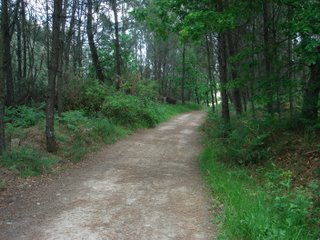
Well, I had to stop and ask around, because so far I had figured the road to Santiago simply followed the highways I had been on, for I had there seen the indications, but in truth, the way to Santiago is much more beautiful and interesting: it goes cross country passing through little babbling brooks on old medieval bridges, weaving in and out of typical Galician villages, and leading the pilgrim to churches, monasteries, old hospitals, monuments, wayside crosses and other similar reverent markings, designed for the pilgrim to stop, give thanks for the journey, and in essence, contemplate the whole spiritual meaning of the Way.

About halfway through the day I finally found a side road with the characteristic yellow seashell symbol of the Way intersecting my highway, and took it, but soon enough found myself in the middle of some village a ways away from the paved roads and clearly heading far away from and perpendicular to where I was meant to go (the Road to Santiago is more or less parallel to the highway, I had been told). Though I had seen the the indications at the beginning, they had soon vanished, and the only thing left were arrows, some painted in yellow on lamposts, walls, and the like, and others in white on the paved side-roads, but as some of the white ones had numbers and pointed to little circles on the ground, which I (I believe correctly) deduced belonged to land surveyor's markings, the yellow ones (which as it turns out were the real indicators of the Road to Santiago) might as well have been pointing to telephone poles that needed fixing, so in no time I found myself getting off the bike looking ahead onto a lonely road flanking a microscopic village leading far into the (wrong, as it turns out) distance in one direction and curving to who knows where in the other.

I was thus so situated, when all of the sudden a little vivacious old woman, clad all in black but walking a springly and vigorous walk for someone her age and with a cane, appeared suddenly like a sprite out of the hazy distance. As she neared, quite a bit shorter than I am (and I am quite short!), but cheery and radiating a zest for life, I couldn't help smiling sheepishly as I asked for directions. "The Way to Santiago!" she said, in Galician, which sounds like a mix of Portuguese and Spanish, and which after my 3 weeks of communicating with the patient Portuguese in my horrid Portuñol, which is not far too different from what I was now hearing, I could understand perfectly, "Why," she chuckled, "it is not this way."

"Er, yes," I said. "That far I was more or less able to figure out...." I blushed.

"Come," said the little old woman. "Walk with me." So I did, though not quite sure where she was leading me, or how long this would take, for we were heading in the direction I came, and that (where I didn't really want to go back again) I would doubtless be able to accomplish much faster on my bike....it was nearing 5 o'clock already, with over 35 kms to go...

"Do you know where you are?" she said, and grinned as she continued walking brightly with not a single care in the world.

Now, I never know how to answer questions like that. They can be rather deep sometimes. How many people really do know where they are at any given time in their life? And this could evolve quickly into a long conversation, rife with complications due to the twisting turns of the Galician language which, though I could more or less handle, was not really my improvised Portuñol, so instead of attempting a guess or explanation so as to not appear like a fool (doubtless, after all, that was most likely the impression I had been giving already for a long time, what with being so far away from the highway and in my fluorescent yellow jacket like a bullseye in sober, gray-claden...whereverIwas, with 60something kilometers alone on a bike behind me, without a job or home or country in a foreign land, etc. etc. etc, and so on and so forth), a situation with no longer any remedy, I decided to go for the simple: "No."

Here her smile turned to one of glee, as if she were proud of sharing this piece of invaluable information: "You are in Extramundi."

Indeed. I had seen the signs with the name of the village only 200 meters before. However, hearing it from the lips of this sprightly little old woman whose eyes twinkled mischievously like she knew something I didn't, who appeared ghostly out of nowhere in the middle of my lost way to become my fortuitious Cicero, I couldn´t help but think: "How appropriate." I was quiet, for I felt then a bit like Dante finding Virgil.

And among these musings and fragments of gay every-day conversations, little by little the little old woman all in black led me back to the highway, the correct highway, from where I had started, only one or two kilometers from where I had lost my way.

"And the way to Santiago?" I asked once more before she left me.

"Follow the highway," she said, portentiously.

"But the highway is easy, I want to go through the real road, the road of the Pilgrims."

"What?", laughed the woman, "you want to go weaving in and out between the villages?"

"Yes! Most ferviently!" said I.

"Ha ha ha. Are you sure?"

I stared at her, dumbstruck (for what had I been trying to tell her for the past 20 minutes?). A pregnant pause ensued.

"Well, follow the highway, then," she finally said, "In Iria Flavia, you'll see a Church. Ask again when you get there, it is too complicated for me to explain to you from here."

And with this, she bid me adieu, and dissappeared round a bend in the road, leaving me, with directions and knowing where I was going, but just as lost and confused as I had been before.


Anyway, it was not long before I reached Iria Flavia, and right by the churchyard, I found the characteristic indications of the Road just like the little old woman had said (by now, too, I had figured out that the yellow arrows were also indicators of the Way). I quickly took to the side-roads, and was immediately blown away by the beauty of what I had been missing (you can take a look at some of the videos here). The ride was a bit technical (I was quite glad I have a mountain bike), what with the dirt and gravel roads rife with rocks and roots and broken land, a bit reminiscent of the rides to the river Serio (do you remember, Father?) of my Italian childhood summers. Still, absolutely worth it, even in spite of the reduction in speed by a factor of 3 as compared to riding on paved roads with impolite traffic.

I arrived in Santiago late in the day, for reasons obvious, and found that as I neared the city my eyes started watering profusely. What kind of eye irritant was this? I could detect a faint smell of glue, or fields, perhaps...chemical fertilizer? Asbestos? It could not be the cold wind of the high speeds on the descents, for I felt it even while standing still, so I endeavored to find out, but no one could give me a reason, for no one felt it. Perhaps, the residents have gotten used to it. Still, it was a rather surprising discovery.

Tuesday, May 02, 2006


Viana do Castelo-Tui-Redondela

Trip dist: 90 kms. Trip time: 6 hrs, 2 min. Tot dist: 639 kms.

Probabilities.

Hmmm....ha ha. It appears that I have unwittingly (unwillingly?) turned myself into a pilgrim.

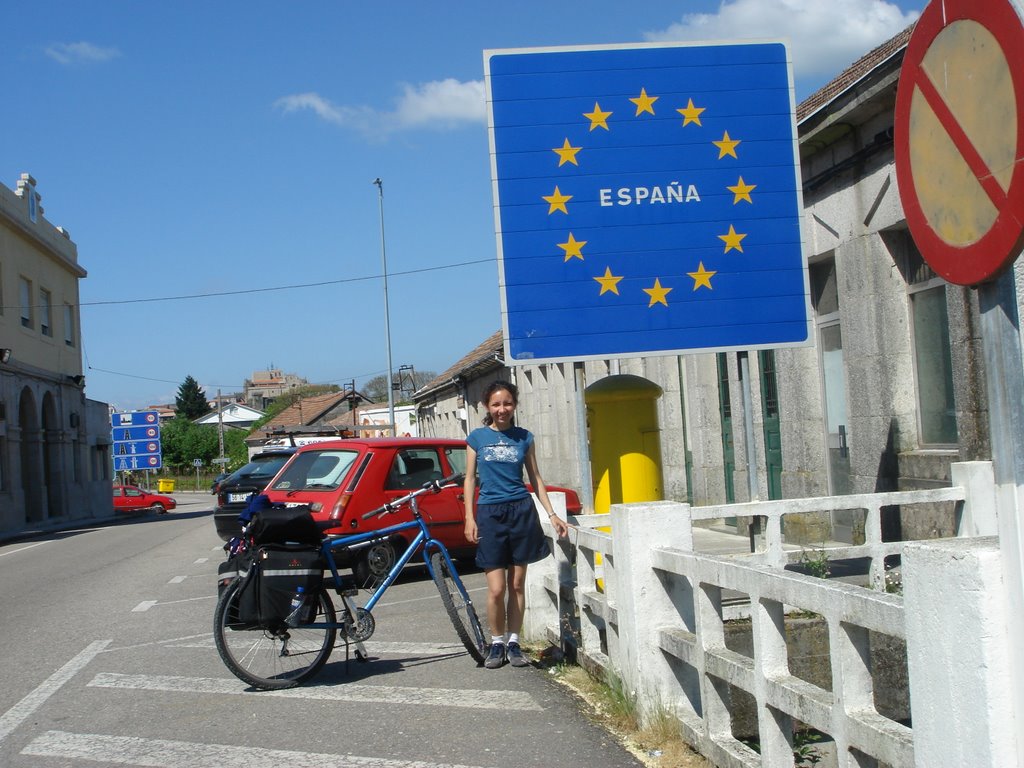
I arrived to Redondela rather close to the hour of the Gremlin, after deciding to press on from Tui, to make a definitive entrance into Spain, and not stick around the border, even though it seemed that since Tui and Valença neighbor each other separated only by the Minho river, my chances of finding good accomodations would be better there. In Redondela, it turns out, there are no easy hotels, when I asked around near the town center, someone quickly directed me to the Pilgrim's Refuge right across the street, which is free, as it turns out, for those pilgrims headed towards Santiago de Compostela along the Portuguese Route.

I had a bit of trepidation walking in to the hostel, it seemed strange and unfamiliar, and, most honestly, I felt a bit as if I had no right to be there. But in an emergency, I figured, I'd just end up paying 10 Euros or so for the permission to stay, since I was an outsider and not a "member of the club", so to speak, so I proceeded to drop by the reception desk, and ask how things worked at these Pilgrim's Refuges.

Well, there's no such thing as paying your way to stay as a guest for the night. The Refuges are free, only for one night, and only if you are officially a pilgrim, that is, you are really on a spiritual pilgrimage and this is officially sanctioned by the Catholic Church in the form of a "Pilgrim's Passport", which you then stamp along the way as you visit other Refuges, religious monuments, or Churches of note and which are quite carefully detailed in colorful guides describing all of the possible Ways/Roads to Santiago, starting from all corners of Europe, but most notably the one beginning in Roncesvalles.

Well, of course this was not particularly unexpected, so upon hearing this I just sort of shrugged and asked the volunteer attending the desk whether she knew of any other hotels/hostels/posadas or rooms to let nearby.

No luck. The nearest one was 9 kms away. After biking 90 kms, some uphill, and already close to sunset, this was not an apetizing prospect, and it clearly began to show on my face as it gradually became more crest-fallen as she listed all of the possible hotels surrounding, each farther and farther away.

I stood there for a while, thinking about what to do, no doubt already looking weary from the journey, dusty, cold coming in fast, and hungry, when she opened up a drawer, and showed me several forgotten pilgrim's passports that other people had left behind, all while saying "are you sure you don't have one of these?". "Nope", was, of course, my answer, and stupidly, for with the tiredness the brain wasn't really working all that well, "where/how do you get them, anyway? And can't I get one here and start the pilgrimage from here?".

That's where she explained, that for the pilgrimage to be valid, it has to start at least 100 kms away from Santiago (and if you're on a bike it needs to be 200 kms), so the last village I could've gotten the passport was in Tui. And as I heard this, I couldn't help exclaiming, a bit regretful, "Ah. But I just passed by Tui this morning!"

"Ah!" she said.

And we stood there looking at each other blankly for a while, me, because my brain was struggling too much with weariness to figure out what next to do, she, because her brain was working better than mine, for after a minute or so, she opened up the lost passport drawer again, and started rifling through the set of 7 or so in there, while I still stared about blankly.

In a moment, she produced one of them, that hadn't been stamped much, and had clearly belonged to someone who had started their pilgrimage nearby (just a little farther away than Tui, it turns out). "Look," she said. "Don't tell anyone this [Editor's note: and now I'm sure she'll kill me for publishing this on a blog on the web!], but I'm just going to give you this one. After all, this person forgot theirs a long time ago and they're not coming back to pick it up. And you did just come from Tui, so...I'll just scratch the name down here...." and at this point produced a beautiful, brand new (but "mended") Pilgrim's Passport in my name (you can see a picture of it here), so that then I could spend the night in Redondela, all free and safe and approved on good authority.

I did feel a bit contrite, a brigand impostor ("impostora malandrina!", to be more precise, but I don't quite know how to translate that in English), a heathen, even, what with the spoon-stealing and all the other little pecadilloes I had been accumulating in my last few weeks as a bon vivant and all, but in the end, I figured, I'd just contribute a hefty donation to the contributions box by the common room: after all, that's how things have been indulgently handled for hundreds of years for these kinds of guilty situations, right?

Still, I must've looked very dusty and tired, for at the nearest restaurant where I headed for dinner I was immediately offered the "Pilgrim's menu" (only 7 Euros for soup, meat, dessert and coffee!) and at the end the owner even gave me a little pin commemorating the "Xacobeo 2004" (as to what exactly that was I had no good idea) with the picture of a stylized pilgrim on it for me to pin to my backpack. Ha ha.

Anyway, when you do not have a clear conscience, sleep does not come easily. Either that or the fact that the dorms are mixed sleeping 40 or 50 and like in the Youth Hostels weariness and age does not prevent the travellers from partying at night and coming to bed at two o'clock in the morning, with the associated noisyness that that entails.

So what do you do when you cannot sleep no matter what you try? For one, you listen to some fado (the CD I had gotten in Viana by Amalia Rodrigues was most excellent, you can listen to a sample of it here, and review the day as you finally bid adieu to Portugal, land of sailors and cadenced speech and bacalhau, and feel a nostalgia for the country, even if it is not yours, because in some notes fado also reminds you of your land, but that only lasts for the duration of the CD, and the pilgrim's partying and reviewing out loud of their day goes on long 'till morning, so now what?

Well, you think about math, of course. After one o'clock, the snoring starts. And not by one person, but three males that sound like a cadre of broken trucks as well as by one woman, who one would expect would sound a bit more quiet, but no. And then the brain works out: In a roomful of 40 people, assuming the probability that any one given person snores is 20%, what is the probability that at least one of them snores? (hint: high! Therefore think twice about sharing sleeping quarters with such a large number of people!).

Or take it to a dance. If there's a probability of 0.5 that the person you dance with is a bad dancer, how many people do you have to dance with to be assured that you're going to end up with stepped-on toes?

Or for instance, harkening back to the days of the medieval pilgrims, and sanitizing the imagination a bit, and making the problem a bit more challenging, suppose the probability of any one person having the flu is one in five. Then, suppose that the probability of you catching the flu from said person is one in two if you shake hands with them. What is the probability of you getting the flu after shaking hands with, say, only 5 people?

And so on and so forth. By 3 a.m., sleep finally comes, but by 5:30, the other pilgrims are up and about, eager and ready to continue their second to last stage before reaching Santiago.

And me: at 5:30 a.m., the only thing I could think about after this sleepless night was: not worth it. Give me a Youth Hostel with its guiltless nights and warm showers and 6 person dorm rooms any day, even if it is at the cost of 15 Euros.

Monday, May 01, 2006


Viana do Castelo.

What a charming little town. Decided to stay here a day, instead of pedalling off immediately, what with the lure of the beaches, the nice peaceful town center, but most importantly, because I knew this would be the last Portuguese city I would be able to spend any time in before crossing onto Spain, and there were a couple of errands I still needed to run and loose ends to tie up (I wanted, for instance, to obtain a CD from famous fado singer Amalia Rodrigues, which I forgot to do in Porto, and once outside of Portugal seemed difficult to find).

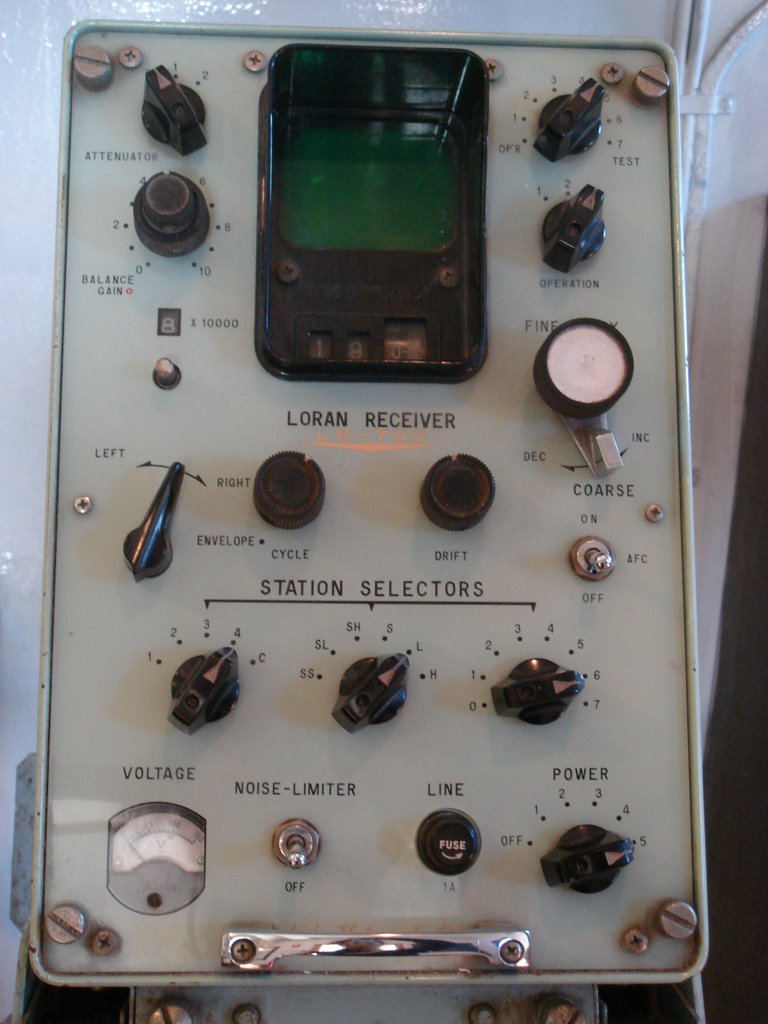
One of the interesting things in Viana do Castelo is the hospital ship Gil Eannes (see pictures here), which is docked here for visiting after being retired back in 1974 (when it was to be sold for scrap! Luckily the citizens of Viana rescued it before that happened...). This ship serviced the cod fishing industry, running along and helping any injured fishermen it could find, and unlike most generic ships you can visit in almost any port city, this one is very nicely organized inside with engaging exhibits and explanations, and of course since it was a hospital ship the way of adapting hospital equipment to sea life was quite interesting, for as you know hospitals require a high level of hygene and technology that is not usually practical in your typical ship (the picture above, by the way, is a little present for you Trimble folks, I'm sure you've caught that, of course ;))

Another neat thing about the Gil Eannes is that it has been turned into a Youth Hostel. Cool, huh? Unfortunately, stupid Let's Go guide neglects to mention this very curious and exciting fact, with the result that I ended up staying at the other Youth Hostel in Viana do Castelo (a very nice YH nonetheless, I think it is the best I have stayed in so far in Portugal). I have a feeling, that these Harvard folks don't update their trademark guide as often as they claim (supposedly once a year?), or if they do, they miss important stuff, and their history and culture blurbs suck, and so therefore I think this is no longer my favorite guide after all. Yeah, I'm moving to The Rough Guide next at the earliest opportunity. I'll let you know how that one goes.

{sigh}

Speaking of tourist guides, if you recall from Douglas Adam's Hitchhiker's Guide to the Galaxy, the best advice Arthur Dent ever got was: "Bring a towel". You know what the best advice Arthur Dent never got was?

"Bring a spoon".

Otherwise, how else do you get to eat the yogurt and pudding and other various and sundry things you may buy at the supermarket on a lazy afternoon in a little beach town? And everyone always brings a pocket/penknife on trips, especially if "roughing it", and fingers may substitute for forks, but a spoon is a different matter, and not so easy to improvise. So far, I've been "borrowing" the spoons from the Youth Hostel kitchens at breakfast, and return them promptly before leaving. But if things continue like this, and I don't find a shop where I can buy just one instead of the full set of cutlery for 4, the way it is commonly sold, I think I may just have, as nefarious and shameless as it sounds, to simply "borrow one indefinitely" one of these days...

Sunday, April 30, 2006


Porto-Vila do Conde-Viana do Castelo

Trip dist: 89 km. Trip time: 6 hrs 42 min. Tot dist: 549 kms.

Aaah, I could've stayed in Porto for a good while longer. But, need to get a move on if want to make it to Istanbul by autumn, so back to the road it was.

On Sundays, Porto people go to the beach. Just outside the city on the seashore is a nice 7 km-long promenade where people gather for a stroll, biking, rollerblading, and in general enjoy the beautiful weather. Which makes it a very exciting little obstacle course for the pannier-laden traveller heading like a salmon against the current in terms of people traffic-flow. :) Still, a good excuse to take it easy on the pedalling while nibbling on one of those typically summer beach day overprocessed ice-cream sandwiches they sell at the kiosks, amidst the characteristic shouts of children, fragments of relaxed conversations in Portuguese, and lazy-Sunday glee.

The ride to Viana do Castelo was easy and nice with pretty sights and bridges, and I would've probably taken less time to ride if it hadn't been for the constant fresh breeze blowing in from the Atlantic, but which, after all, contributed to the general pleasantness of the ride.

Sometime nearabouts Vila do Conde, too, I started seeing the indications for the Camino de Santiago, the famous pilgrimage road to the tomb of the apostle, in most places very well marked, obvious, and protected from traffic, and it was reassuring, for once, to know in spite of my horrible maps that I was headed in the right direction.

Saturday, April 29, 2006


Porto, Day 3.

The imperative Port wine post.

I had been teasing you before, by postponing it as long as possible, also because, not being much of a wine person, and these thoughts being just my very naive impressions, without the requisite conoisseur vocabulary and florid language, well, I was a bit shy to make them public. But, at the same time, as I've said before elsewhere, sometimes you just have to put your thoughts down otherwise it feels like your head is going to burst, at best, or they quickly dissolve with the passage of time never to be recollected again. As Conan Doyle once said in the words of Sherlock Holmes (paraphrased here): "The mind is not an ever-expanding room which you can perpetually furnish with dust-collecting facts", and ephemeral impressions, in my particular case, and once written down, one can rest assured they are well kept for future reference and one can then further concentrate on other things in a more orderly fashion.

So, if you know all about Port, and I'm just preaching to the choir here, feel free to skip the post. These are mostly just my notes from the past 3 day's afternoon strolls across the bridge to the other side of the river, set to cyber-ink and paper before I forget them a few months from now when my thoughts get preoccupied with other matters.

So...

There are 3 main types of Port wine: whites, made from white grape varieties like Viozinho, Rabigato, and Arinto, and ruby and tawny, made from red grape varieties most notably Touriga Nacional (said to be dense and concentrated), Touriga Francesa (said to be fruity and full bodied), Tinta Roriz (said to be firm and delicate), Tinta Cão (classic, reliable, and one of the oldest grown in the Douro Valley), and Tinta Barroca (rich and fragrant. I say "said to be" because I have not had occasion to taste the actual grapes myself, so I cannot directly comment. Still, this gives you an idea, more or less). There are of course a lot more varieties growing in the Douro Valley that are used as well, but these are, it is said, among the best, and therefore most commonly used, or, more properly speaking (since "common" has such a pedestrian ring to it), most often used and sought for. ( ;) For you wine snobs, that a bit better?).

Now, out of the white Ports, there are several types ranging from dry to medium dry to sweet, also known as Lágrima (which, trivia fact, by the way, has around 136 grams of sugar per liter!). These are typically served chilled as aperitifs and have a very fruity taste sometimes with a hint of lemon. They tend to get darker-hued as they age, progressing from golden to dark amber.

The rubies are different from the tawnies in the way they are aged: Ruby wines are aged in large twenty-thousand liter oak vats for between 3-6 or so years, depending. Simple rubies age for around three or so years while Reserve rubies age for 5 years or longer. Since they age for relatively little time with very little opportunity for oxidation (due to the relatively little contact with the wood) they tend to retain the characteristics of a "young" wine, namely, freshness, fruitiness, marked taste of "black fruits" (i.e. cherries, raspberry, currants, plums, etc). These go especially well with chocolate and black fruit-based dessert.

Tawny port ages in smaller oak casks, which with the more surface contact with the wood obtain a more "nutty", and, as they age, a rather liqueur-like flavor as well. These are served typically as after-dinner drinks with dried fruits and, clearly, nuts, or on their own. Most producers offer several varieties of Tawny, depending on the average age in the oak barrels, typically 10, 20, 30, and 40 years. Red grape ports get clearer as they age and therefore in contrast with the deep cerise color of ruby ports they tend to be more amber-hued and transparent.

Now, there is also a particular kind of Port called the Vintage Port. This Port is always from the harvest of a single year and never a blend. These Ports, too, are typically treaded by foot in wide stone fermentation tanks called lagares which is laborious and costly. A Vintage Port, too, is produced only in years where the grape harvest produce was exceptional, and certain conditions need to be met before an official body can declare that particular harvest a Vintage year harvest. So, not only are these ports rather rare, but they also are aged in the bottle, and are the stuff all of those great Victorian stories are made of: namely, they keep basically forever (I saw one at the Sandeman cellars from the year 1908!), need to be decanted (for they form sediment as they age in the bottle), and can fetch for thousands of dollars at auction if particularly old.

Nah, I haven't had occasion to taste one, even though they do say that 1975 was a nice Vintage year. But, tradition says you drink the Vintage of the year of your birth when you reach the winter of your life. So I have long enough to save up some money yet, I hope. ;)


There is another kind, which is a bit like a compromise between a normal Ruby and a Vintage, and that is the Late Bottled Vintage. These are vintage ports aged for a couple of years in the barrel, and then in the cask/bottle for another 4-6 years. This wine is ready to drink, needs not be decanted, and if I remember correctly doesn't quite keep as well for as long.

Now, Port wine is a fortified wine, the reason it tastes so sweet. Back in 1703 when the British signed the Methuen Treaty which lowered the duties of Portuguese wine relative to those of France (with whom they were rather unfriendly at time), thus becoming the number one Portuguese wine market (and Adam Smith has a lot to say about these kinds of trade policies in his Wealth of..., by the way, going as far as using the Portuguese wine trade as an example...but I digress). The problem was that the wines did not travel well in the short trip across the sea, so the traders added brandy to them to prevent them from spoiling. Nowadays, pure grape spirit (aguardente) is used (colorless, and regulated to something like 77% alcohol content), and what this basically does is that it cuts short the fermentation process such that most of the natural grape sugar remains in the wine.

The Douro Valley, which is about 150 km east from the city of Porto (and unfortunately too far for me to bike through there, since it looks spectacularly beautiful from the pictures!), was the first ever officially demarcated wine region, by the Marquis de Pombal, back in 1756. It consists of the 3 regions: Alto Douro, where most of the Port wine grapes come from, Middle Douro, and Lower Douro. Two things make the Douro region unique: first of all, the mountainous terrain of the Marão, which protects the grapes from the winds of the Atlantic, and makes it very cold in winter and baking hot in the summer, with a variety of micro-climates along the region, and the type of soil, which is full of a rock called xisto (schist, I believe, in English), which is very hard to break and often requires dynamite to do so. On this rocky and mountainous terrain, the Portuguese wine producers build little terraces, some according to old tradition, following the contours of the mountains, and more modern versions running in rows perpendicular to the hillside, along the gradients. Because the soil is so rocky, this requires the vines to put forth long and strong roots in search for water, which somehow also contribute to the unique quality of the grapes produced.

Anyway, after listening to the little story/tour outlining the above for three or four times, you end up remembering it. That's why I wrote it up for you above. After the tours, you get to do some wine-tasting, as I've hinted before. If you are a complete newbie, like me, the first few tastings are spent training your senses and memory to distinguish between the types of Port mentioned above (but in a simplified way: just whites vs ruby vs tawny, and the occasional LBV or reserve). This doesn't take too long, however, and by the second or third tasting you're easily able to tell which kind of Port it is even without looking at it.

Here's where it gets interesting. After you can easily distinguish the types, you suddenly start noticing slight variations in the same type of Port between different wine producers. Perhaps one of them here produces a wine that is rather "flat", or homogeneous. That is, the wine tastes of "one thing", not necessarily only one flavor, for it could be a mix of things: maybe apricot as well as cherry or whatever but the point is that the flavor, blend or not blend tastes the same throughout the time it takes for the wine to first touch your lips to the time it leaves your mouth. There is no "group delay", between the different component flavors, so to speak (for those of you engineering types), they all arrive at the same time and stay at the same time, the "taste vs time" function is a constant, and if you could somehow take the Fourier Transform of the taste in time, with the frequency axis becoming a "taste frequency" (a la "spatial frequency" of the 2D Fourier Transform, where "frequency" has nothing at all to do with number of periodic oscillations per second), it would be an impulse centered at the "predominant taste", or if not an impulse, at least a very narrowband spectrum. Does this make sense? To give you another example, ever tried the "tutti-frutti" juice flavor? How it is a blend of several fruits but in general when bottled up by a major juice company it no longer tastes of the individual fruits that make up the juice but tastes instead of an undefined, "new" flavor that is called "tutti-frutti" but as to what exactly the components are it is hard to tell if the blend is made such that not one taste predominates: you can tell a few components, maybe even all, but it doesn´t taste of any one of them at any given time, it simply tastes of "the blend". That, to me, is a "flat" wine. It is also, to me, rather boring.

The nicer wines, the ones more interesting, the ones I call more "complex" (but I don't know if this is what other people refer to as "complex", perhaps a knowledgeable person can comment here later...), have a nice "group delay". They taste different the instant the liquid touches your tongue, then some other taste or impression takes over, and then at the end it is something else, still, perhaps a spyciness, and it is cool sometimes to distinguish, between one winery and the next, whether the spyciness is from something like cinnamon, for instance, or pepper instead, one biting but sweet, another piquant and warm. Have you ever looked at a Van Gogh painting up close? His brush strokes are never only one color. If you look carefully, and you have to be standing very close to the painting to be able to appreciate this (and it has to be an original, of course, a poster or a photograph won't show this), you will notice that his brushstrokes look like the brush was holding at least 3 different colors. The blue you see, yes, it is blue, but it has white and yellow edges. Van Gogh saturates the brush with paint, so that when the brush strikes the canvas the predominant color (the blue, let's say), is in bass relief, the edges, white and yellow, very narrow strips of, stand at about a millimeter or two above the canvas, deliniating the stroke. And when he puts another brushstroke right beside it, the delineations do not blend into one another, they stand there still. But you need to be close, pay careful attention, to notice this (from afar, it will simply look like a blue brushstroke). Such too, a fine wine, I think.

The wineries. As I had occasion to visit the cellars of several over the course of 3 afternoons, I soon began to notice, not just the difference in tastes between the same kind of wines executed by a different producer (a Mozart--a simple, straight forward composition---played here by Von Karajan---flat!, another here played by the Academy of St. Martin in the Fields--complex!), but eventually, too, a common denominator between the varieties of wine within the same producer. Thus, Sandeman, high alcohol taste, which tends to overpower the more fundamental flavor of the wine not just towards the end, but as early as the middle...not fun, in my opinion. Or Quinta do Noval, nice, but not too complex. Fonseca, reliable, the type of Port I would keep at home for the occasional guest, in the words of a friend, "to be trusted", indeed, but not extraordinary, I found. Ramos Pinto....

Ah, slight digression on Ramos Pinto, because this producer is a very interesting study in marketing. Ramos Pinto came rather late to market, founding the company in 1880, a good 150-200 years later than some of the other, more established companies. What this effected was that Adriano Ramos Pinto (the 21 year old founder!) had to come up with some really innovative ways to sell his Port wine, and he did this very intelligently in two ways: 1. He concentrated first on exporting to Brazil, a still relatively new market, and 2. Once he was established as the leading Port producer consumed in Brazil he followed with an aggressive, controversial advertising campaign quite successfully back in Europe, engaging the most renowned artists of the time to design his posters and bottle labels, as well as marketing/promotional gifts, which were of very fine class and soon became collector's items (combs, accoutrements for women, fountain pens, cigar accessories for men, etc). You may recognize them because some of them have become classics of Art Nouveau (see pic above), and he always made sure that all of his advertisements and labels were quite a bit controversial for the time (see for instance, this one, which is rather tame by modern standards).

Anyway, Ramos Pinto, for all the "artistic" atmosphere of his marketing, I found his wines of a rather "masculine" aroma, with hints of raw tobacco and cedarwood, and clearly more of a liqueur than wine.

Taylor's is also an interesting producer of note: Taylor, Fladgate and Yeatman is probably one of the oldest Port producers, founded in 1692, and to this day still family owned, never sold or taken over. Their Ports are very nuanced, subtle, and delicate, "feminine", if you will, almost at the opposite end of the spectrum of Ramos Pinto, character/personality-wise (and I find them difficult to appreciate in a noisy room or where there are a lot of visual distractions...I miss a lot of things with these wines that way). There are some who say that you haven't lived if you have never sipped a glass of Taylor's 40 year aged Tawny with the sun setting behind the banks of the Douro and gazing onto Porto (Eu tenho setenta anhos. Eu sei o que eu digo...).

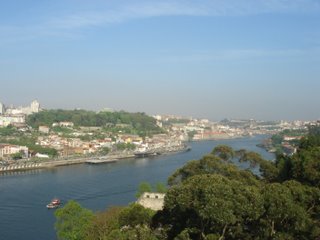
And this evening looking down the river in Vila Nova da Gaia, exhaling a sigh of contentment as the last drops of liquid caramel that follow a wonderful meal faded away with the dying rays of sunlight, perfectly free, unperturbed and unafraid of the thought of the ephemeral and solitary nature of this kind of happiness, I couldn't help but agree.

Friday, April 28, 2006


Porto, Day 2.

Strode over to the Stock Exchange, a nice palace we had missed yesterday since it was closed. The highlights of the visit included the General Assembly room, the walls and ceilings of which were painted in trompe l'oeil to resemble oak wood matching the furniture good enough to fool the closest inspection.

The other interesting feature of the Palacio da Bolsa was the Arabian Room, decorated in a rather baroque-like way with arabesques in stucco all over the walls, columns, and ceilings and hand painted on the windows in a noisy attack on the eyes enough to send anyone reeling. This room was designed and built by Portuguese artists during a time when the whole Arabian theme was seen as exotic and fashionable, but I very much doubt these guys had ever set foot in an Islamic country. At least, the room looked nothing at all like the Medersas and Palaces it was supposed to draw inspiration from that I've ever seen. Yikes, what a mess. {shrug}. However, it the room does inspire the sense of opulence, which I believe was the intended effect, however clumsily (in my opinion) achieved.

Anyway, another salient characteristic of the room was its supposedly "near perfect" and "wonderful" acoustics, ideal for concert hosting. Of course upon hearing this from the lips of the guide and having them echo noticeably from where I was standing nearby (remarkable acoustics, certainly, but not good for concert hearing!), I immediately walked away from the group to the extreme corner of the room where the echo was eliminated, and the difference in acoustic quality was striking. Again, not the ideal situation for a concert hall, if what you hear depends a lot on where you're sitting! So I started to become rather skeptical, and wondered if piano recitals would sound as overornate as the overwhelming decor of the room in question, what with the rather "wet" sound of the room, and the rather long sound permanence/reverb time/low absorbtion even at the far end away from the speaking guide, and decided it may perhaps not be too bad for some chamber works if the hall was full, but as it was, hearing the guide, it was not "near perfect" to me at all, but very far from it.

A little bit of reassurance ensued, when the guide mentioned in passing, at my remark that I thought the reverb time was rather longish for such a small room, perhaps around 1.8 secs or so was my guess, and whether she knew the exact number (she didn't, which was unfortunate, because I wanted to see how good my guess had been), that when the piano concerts took place, the piano was placed in the middle of the room, and the people took seats around it.

Aaaah, then. That makes a huge difference. With people surrounding, full hall, reverb time goes down, and with the piano in the middle, the listeners get more equal effects in terms of echo so that seating arrangement only matters, one hopes, in relation to the seating position with respect to the piano (i.e. near the sounding board or behind the pianist, as opposed to near the stage vs. far from the stage in a traditional concert hall). Would've been interesting, to catch a performance, but the next one is not until May 6th, which is a pity, as I'm hoping to be somewhere in Spain, by then.

Still, a very capricious and bizarre room, for my taste. There sure are some rather strange things to be found here in Portugal.

Thursday, April 27, 2006


Porto, Day 1.

Camila, Brazilian friend, roommate from stay in Lisbon, who is currently studying/living in Braga, had entreated me to ring her up as soon as I approached Porto for possible hangout. Did so two days ago, while in Aveiro, and went to meet her at the train station today at 1:00 p.m. (It is uncany and wonderful, isn't it, how easily friendships are made while travelling?)

Before that, having a lot of time to kill, went out to find a laundromat and do some window shopping. I recently figured it all out about laundromats: the trick is to do your laundry in small towns, where they can finish the job easily in a day (most people here, it seems, do not use laundromats, they either wash at home or....I guess they wash at home then {shrug}), for in the big cities it seems they are always too busy--took me three laundromats before I could find one that could do the job in a day. And I only have like 4 T-shirts, and all my socks to wash (the rest can be washed in hostel, dries faster, but socks never dry on their own after washing, and besides, everyone knows they always disappear since they're either pairing averse, or recombinant-phillic, for you biology-inclined folks ha ha, so....)!!

Speaking of socks, had to buy another pair (see above). But this one came bundled up with a second, so, might as well be pretty socks, right? I got me some nice blue-and-green-striped ones, a la Cat in the Hat, only ankle length. Cool, huh? (maybe I'll post a picture of my "European" sock collection one of these days, it is getting rather variegated as I haven't been able to keep buying them all white the way they should be).

Anyway, after catching up with Camila over some nice buffet lunch (cheap! for 7 or so Euros you get quite a nice variety of stuff: pork spiedini, rice, fish, fruit, you name it) we headed off to the Torre dos Clérigos which is the tallest tower in Portugal. Had nice views and all, but only 240-something steps. So it is not too tall, after all.

From there we stopped at the Sè Catedral to admire the azulejo-covered cloister before heading for the fun part: wine tasting on the other side of the river, at Vila Nova da Gaia, across the magnificent Ponte Dom Luis I.

Aaaaah, what a beautiful, beautiful day. The wine tasting part, man, now I understand a California friend of mine. I could do this forever. And chattering the day away with Camila was so much fun. Wine tasting, like many other things, is so much better in good company.

Wednesday, April 26, 2006


Aveiro-Estarreja-Ovar-Espinho-Porto

Trip dist: 81 kms. Trip time: 6:16 mins. Tot dist: 460 kms.

(Clicky on picture above for movie)

Elastic pills.

Ride to Porto from Aveiro was rather boring, for the most part. Flat and easy but not much to see other than generic little towns the looks of which one could easily just substitute in place for one another and it just seemed like....hey, you know, Mexican author Juan José Arreola once wrote a short-story in his book Confabulario (a very nice book for cold and lazy rainy afternoons, by the way, I heartily recommend it) called El Guardagujas (I believe translated as "The Switchman" in English), about a train track-switching operator (bear with me here, this is relevant. Just hold the thought while I finish this apparent tangential diversion). If you read Spanish, you can actually get the whole text of the short-story in question here. Anyway, in it, he describes how sometimes, the train company operators at this station in the story scroll moving landscape paintings through the train windows in order to give passangers the illusion that the train is moving, even when it is not, complete with elaborate sound tracks and cabin movements. You know how you sometimes are watching cartoons on TV, and the cartoon character for some reason or another starts running, but what actually happens is that the animated figure just moves its legs in place, figure always on the same spot on the screen while the background moves instead? And how, after a while, the background motif, which kind of looks as if someone is just rolling the landscape tape, suddenly ends, so it wraps around and you start seeing the same background all over again as the figure keeps running but going nowhere? And the worst thing is, it rolls and wraps a little bit too often, just often enough to keep the sequence dull and annoying if it lasts for too long?

Well, the ride to Porto from Aveiro was kind of like that.


It is amazing, though, the kind of games the mind comes up with when it's bored.

For instance. Do you know how you say "chewing gum" in Portuguese? Pastillas Elasticas. Elastic pills. Amusing, huh? I discovered this on a short stop at a roadside cafe/pastelria/bar/restaurant. They looked kind of cute, and who could resist the opportunity to tell the friends: "What, you mean you've never tried Portuguese elastic pastilles?", so I bought a few of them.

And the games began. You start riding, 60 kms to go, fairly hot weather, dull and boring (and probably, no, surely, it must be, wrap-around repeating) landscape. You have 5 pieces of chewing gum, all different flavors. To optimally distribute along the trip, of course, you have to chew one piece no more often than every 12 kms. But if the flavor of each elastic pill lasts only 2.4 kms (and I know this exactly, for I measured it), then what? Do you step up the pace of the pedalling to make them last longer, distancewise? Or do you slow down the chewing, to make them last longer, timewise? And how much rest between flavor switching do you need to optimally separate the different flavors of gum so that they don't get mixed together and confuse themselves? And boy I just passed this tractor on the road don't I get a chewing-gum reward? And oh, how curious, this blue cotton-candy-flavored one with pink speckles, it tastes exactly what the after the rain California clouds and sky look like!

And so on and so forth.

Sometimes, you get lucky, and a diversion is provided by the events of the road. Let's say one of the townspeople passes you on his bike on a slight ascent (since you've geared down--up? I never get them right--to minimize the effort, and his bike is only 1 speed, so his cycle travel is longer). Pride of course tells you that you must try to overtake him on the flat stretches, and you do so with little difficulty. But then, of course, this results in wounded pride on behalf of the townsperson, who then very discreetly, for they can't say anything while you're passing them, even though you turn to look at them with a whimsical smile to say: "See, I know you passed me before on the uphill, but so what? On the flats I pass you and I'm carrying 40 kgs of luggage!!"), they try to keep up right behind you as long as the flats last and at the next slight incline---ZAP!! They pump up hard and standing up and with super human effort pass you as you leisurely gear down and continue pedalling with the same stride, just slower, saving all your energy and meanwhile chewing gum at your leisure.


I always let them win, in the end. They're not biking to Istambul, after all. ;)


Anyway, ride to Porto veredict: easy, but boring. It only got interesting on my ascent from the coast to the Ponte da Arrabida from the beach, where it got pushwalk-the-bike-with-its-40-kgs-of-luggage-at-2.5-kms-per-hour-with-no-traction-sneakers-for-a-full-kilometer-or-two-at-at-least-17%-steepness-grade-oh-my-God-I-think-I'm-going-to-die strenuous (yes it was way worse than Passo Cisa, only, thankfully, a lot shorter!).

But, at the same time, I discovered Porto gentlemen are quite gallant and one does not need to wear a flirty skirt to be a damsel in distress. The two cyclists who helped me on the bridge, one at the entrance, giving me directions, and the stockbroker at the end, riding with me to the center of town, were most amiable and quite good-looking, too.

Not a bad ending for the day's mental and physical exercise. :)

Tuesday, April 25, 2006


Coimbra-Cantanhede-Aveiro

Trip dist: 82 km. Trip time: 5 hrs 39 min. Total dist: 379 kms.

(Clicky on picture for movie)

Dolphins.

Aaah, this is what bike rides should be like. What a nice, short, easy ride from Coimbra to Aveiro. If I were running a bike-touring company, this is the ride I'd recommend for Portugal. Flat, quiet national roads with scant traffic, through lush young forests and little towns chockablock full of azulejo-covered houses.

Heh. You know how sometimes, when you're in a ship or boat out at sea, dolphins like to swim behind the wake of the boat, and they play and cris-cross around and in front of the hull, and everyone watches, enthralled, because they seem to have so much fun, and they're so cheery and happy and it is like a bit of good luck?

The same thing happened to me as I was passing one of the towns. All of the sudden, I hear the jovial calls of some 7 or 8 youngsters aged 14-17, who caught up with me on their mountain and cross bikes, rode with me for a brief minute or two, criss-crossing each other and surrounding my bike as I rode, and then at the quick command of one of them suddenly veered off and vanished onto one of the side-roads as quickly as they appeared.

Gave me a few minutes of chuckling, that one. Put me in a good mood. :)

The weather was quite warm, summerlike, almost, but the scenery and easy ride made up for it, and it was such a nice ride I truthfully didn't want it to end, that is, until about 10 kms from Aveiro when a passing car unintentionally splashed me with about a bucketfull of some pothole-marinated brackish water, at which point I pedalled as fast as I could to reach the safety and showers of the Aveiro Youth Hostel.

Monday, April 24, 2006


Tomar.

Day tripped by train to Tomar. I think I spent more time in the trains and train stations waiting for connections than in Tomar and surroundings combined. Which kind of sucked.

Anyway, Tomar is interesting because of the Convent of Christ, which was the site and base of operations for the Knights Templar. It used to be a Moorish stronghold, but then the Christians took it over and it was important in the push to recover the southern parts of Iberia. Of course after the Templars were dissolved the castle changed hands, first to the Order of Christ (ergo the name the Convent of Christ) then to some royals, and eventually to the state, for your and my viewing touristing pleasure.

The architecture is quite interesting, again, long histories tend to beget a bit of a mish-mash of styles, but I was happy with my visit, and on the way down to the center of town my brain was playing Il Vecchio Castello from Mussorgsky's Pictures at an Exhibition over and over in my head.

Me wanna buy me a castle. Carlos, my man, when are you going to make a killing in the stock market? :P

Pictures at the usual spot (just be patient, the uploading may take a while---very painful from internet cafes, as you know).

Sunday, April 23, 2006


Coimbra.

It is Sunday. Where are all the people? I mean, you'd think, that if the day is of rest, they'd come out of their homes and hang out somewhere, right?

Looks like desert town here. Even though Coimbra is about as big as San Francisco.

Anyway, most of today I simply hung out, was way too tired to do any serious sightseeing or hill climbing (by the way, the cool thing about many of these Portuguese mountain cities is that they have conveniently-located elevators and funiculars all over the place! A lot of fun to ride, too. And my legs were thankful. :) So what if you think I'm a Warmduscher/lazy bum? I wanna see you after 100 kms of uphills!). Read a bit, even went to the movies (saw "The Insider". Cool movie about some bank robbers--my favorite kind. I've always wanted to rob a bank you know. So nice to see movies about the career you would've chosen had you had a bit less scrupules--or more freedom of choice, however you want to see it. :P). Saw a bit of the University--quite pretty, too.

Highlight of the day was probably the Octopus rice I had for dinner. Pretty good.

Tomorrow: Day trip to Tomar before I get too far along north to make it practical.

Oh, finally found out where all the people hang out on Sundays, too! Why, they're at the mall!! And near the mall there was an indoor soccer field, where the finals of some championship were being held. That's where all the kids, men and women up until the age of 40-ish were. They buy these long knit scarf thingies that they tie around all over where someone can tie things to one's body: neck, arms, waist, legs, you name it. Then they go wild calling out the name of the teams. Cool, huh? This time I think it was Benfica vs Pombal. Since I was wearing a red polo shirt that day, I think I was rooting for Benfica by default. Not sure if they won, though. After I came out from the movies the Benfica fans were moping around looking kind of dejected, so...

{shrug}

Saturday, April 22, 2006


Nazarè-Marinha Grande-Leiria-Pombal-Coimbra

Trip dist: 108 km. Trip time: 8 hrs 17 min. Tot dist: 297 kms.

Pilgrims.

Note to self: Elisa, beware the Siren's call of the Atlantic.

Going downhill/to the ocean is a bit like buying on credit: very nice now (on the downhills), but you pay (hard) later, should you then head inland.

Anyway, ride to Coimbra was a bit strenuous, mostly because of the climbs from Nazarè, some rather stressful stretches of road (very fast and high volume traffic on IC2 from Leiria to Pombal), and the fact that I stepped up the pace from Pombal to Coimbra (I had arrived to Pombal at 4:00 p.m., and it seemed too early to stop for the day, but Coimbra was 45 kms away, and very tempting given it is a rather big city--internet access ahoy!--but need to get there before the Gremlin hour, so....pedal like a banshee, basically).

Along the way north, starting from Pombal, more or less, I noticed people on my side of the road walking towards me wearing the reflective orange and yellow high-visibility vests that work crews tend to wear when fixing potholes. Only, these people were not work crews, as they were of a rather variegated sort: men, women, some children, but mostly women between the ages of 40-60, with the occasional male escort, always in groups of two to five, and carrying only a water bottle or a sweater, if anything.

I figured they were some volunteer group doing some sort of highway cleanup heading back towards Pombal after a day's work, and didn't give much thought to them, until I was about 20 kms away from the city in question, and a lot closer to some other fairly populous towns, and saw that the groups had not thinned, but continued walking, always in the direction of Pombal, and only on my side of the road.

Now, you'd think that if this were some sort of "keep our highways clean" campaign, they would distribute themselves more or less evenly along the stretch (which by now to me started looking a bit excessively long), with the result that by the end of the day, the volunteers would walk back to the towns they came from, some of them, then, necessarily, in the opposite direction as well, right?

But why were they all walking downhill in the direction of Pombal, then? This seemed a bit too deterministic...

The mystery cleared up 10 kms away from Coimbra, when I stopped briefly at Coninbriga to buy a chocolate bar and drink some juice at a side-street bar. A group of three fluorescent-vested folks had chosen to do the same (substitute Coca-Cola for juice) and I asked them, why was everyone walking southbound?

Turns out, they were pilgrims to Fàtima (which was, by this point, about 100 kms away!), this particular group coming all the way from Aveiro (another 70 or so kms away!), and doing all of the stretch walking, of course. (Does this start to sound like The Canterburry Tales to you yet?) Wow! Nutcases, if you ask me.

{shrug}.

Still, these pilgrims are quite a bit smarter than I am. They go southbound, downhill, for their pilgrimage. It is only me who buys on credit, then arrives crawling at the hostel in unforgivingly mountain-encrusted Coimbra regretting every second of it before collapsing onto bed.

Friday, April 21, 2006


Batalha/Alcobaça

Day tripped (by bus. Both of these townies are only 20 or so kms from Nazarè, but biking the round-trippy through uphills is a big pain in the neck) to Batalha and Alcobaça, two must-see UNESCO World Heritage Sites, mostly because of the monasteries.

In the Church of Santa Maria de Alcobaça, the acoustics are impressive. What do you expect with a vault like this?

In the Batalha Monastery, one of the most interesting features is the Tomb of the Unknown Soldier, dedicated to the soldier that died in the great war 1914-1918.

They also have a museum of offerings to the unknown soldier: everything from banners, photographs, engraved stone tablets, medals, crowns of flowers, palms and olive branches of bronze, plaques, letters, ornaments in filigree of gold, from presidents and ambassadors and representatives of all countries: USA, Germany, Spain, Hungary, Poland, France. They even have medals (of all sorts, of valor, conmemorative, etc) from commanders, lieutenants, and soldiers of future wars, some too, who also died in combat, many years since.

And as I wandered around the room filled with all these reverent treasures, I couldn't help thinking: What bulls$#%t. None of this is worth anything, the moment a kid dies alone in a war that is as nonsensical and meaningless as this collection of trinkets.

Tomorrow: Bike to Leiria and onwards to Pombal, if time permits.

Thursday, April 20, 2006


Torres Vedras-Caldas da Rainha-Nazarè

Trip dist: 78 km. Trip time: 5 hrs 25 min. Tot dist:188 km.

Man, someone should invent some windshield-wipers for the eyes. Road to Nazarè was fairly flat, difficulty moderate, but it drizzly-rained for about two hours' worth of the ride, and for a while there I was as soaked as if I had taken a swim in the Atlantic.

Oh, by the way, I figured out something important. The rides lately have been cold and windy, so I ride with track pants and fleece sweater and windbreaker, so I'm all covered up, pretty much. This morning, in the shower with the warm water, I felt that the back of my hands, the only part left uncovered while riding, were sunburnt from the ride. So that's why people wear bike gloves! {shrug}

Decided to stop at Nazarè, and use it for base of operations for day trips to Batalha and Alcobaça (two UNESCO World Heritage sites within a 20 km radius) mainly for two reasons: 1. The Let's Go guide says that they have internet here, and 2. Who can resist the pull of the golden beaches and deep turquoise waters of the Atlantic?

Anyway, pics at the usual spot.

Wednesday, April 19, 2006


Sintra-Ericeira-Torres Vedras.

Trip dist: 74 km. Trip time: 6 hrs, 19 min. Tot dist: 110 km.

(Cliky here or on picture above for movie)

Note to self: Just because a road looks inviting, with all the pretty trees and quaint views and is all downhill, wishing it were the correct road doesn't make it so.

Note to self #2: Don't so easily trust the directions of friendly-looking little old men.

Started day off on schedule by 10:30 a.m. after stopping by a nearby Pastelaria to buy a sandwich for the road. In the downtown, veered off to where directions seemed to indicate Ericeira, following the flow of most of traffic onto a fairly large and pleasant-looking road. Satisfactorily noted it was all downhill (Sintra is atop a mountain, and Ericeira is on the beach, so makes sense, right?), and settled in for a relaxing, enjoyable ride....until the names of the towns I was passing started to sound familiar from that morning's map check....and not in a good way.

Turns out, I had taken a road perpendicular to the road I was supposed to be on. By the time I realized this, I had already coasted 10 kms downhill and what was worse, there was no easy way to try to cut an hypotenuse (confirmed, too, after asking two or three different people). So, back uphill to Sintra. Took about an hour and a half to get back for a total time waste of 2 hours, let alone the energy drain. Blech!

Anyway, at around 12:30 I was back in Sintra, exactly where I started, but this time I took the correct road, and reached Ericeira at around 3 p.m.ish, through 25 kms of rolling hills, a bit reminiscent of biking through Tuscany (i.e. moderately strenuous), only not quite as pretty (too many brick and tile factories along the way).

Along the coast from Ericeira to San Lourenço there are a lot of steep ups and downs, again, a very tough ride, and made me worry whether I'd be able to reach Torres Vedras on time, due to Subsumption Rule#1, also better known as: "Under no circumstances do you bike after sunset." Luckily, after San Lourenço the road was rather flat (O.K., no, it wasn't, it was slightly uphill, but with a very gentle gradient, which after the 35 or so kms of horrible climbs and descents that seemed too short to match, was flat enough for me).

Got to Torres Vedras at about quarter to seven (trip time, including unintended, 19 km "scenic detour", about 6.5 hrs), after which I ate and promptly collapsed into bed.

Tomorrow: North to Caldas da Rainha, and Nazarè if time permits.

Tuesday, April 18, 2006


Sintra, Day 2.

Stayed an extra day in Sintra to visit Palacio da Pena (was closed yesterday, being Monday), constructed by Prince Ferdinand of Bavaria as a summer retreat. Boy, what a garish piece of architecture (pics here). What a mish-mash of styles: Moorish tilework, Manueline windows, German & Portuguese style mess.

Which just goes to show that being rich and royal ≠ taste.

Yikes.

Saw Lisbon from one of the Palace towers, with the two bridges (Vasco da Gama and 25th of April) flanking it. Neat seeing that and thinking: Oy! That's where I just came from, 35 kms away!

Then went and visited the Quinta de la Regaleira. Would make an awesome hotel. But the coolest thing about the Quinta de la Regaleira is the initiation well. At the bottom of the well (see movie here), which must be 20 or 30 meters deep, is a cavern, with twisting passageways almost studiously designed to disorient a hapless "victim", and aptly named "The Labyrinthine Grotto", eventually leading to either another little well (see pic here), or to a mini-lake, again a nice place to take your victim at nighttime: challenge them to find the stepping stones by moonlight, otherwise fall onto the pond, all the while with a dog chained to the adjacent stone doghouse barking horrendously....Could come right off The Hound of the Baskervilles, huh?

Heh, these Victorians were sure a strange bunch...

You see, the whole of the grounds of the Quinta de la Regaleira is designed with the allegorical "journey through life"/peregrinatio mundi motif, so all the little nooks and crannies, the well, for instance, the grotto, the courts and lakes and fountains, with names such as "Fount of Abundance", and "Guardian's Entrance", and "Terrace of the Celestial" and the like, are supposed to be little "stops" in an alegorical stroll you can take when you're bored from too much reading at home. I tell you man, the owners must've thrown some really good parties, what with the "make the guests ascend through the Initiation Well from Hell into Paradise and then walk among the Founts of Abundance" kind of thing. Oh, and the garden, too, has lots of hidden corners with little seats built in out of stone, expressly for the purpose for lovers to kissy kissy. Hah ha. {shrug}.


Tomorrow: bike northwards towards Torres Vedras or Caldas da Rainha, then stop.

Monday, April 17, 2006


Sintra, Day 1.

Made my way to historic centre of Sintra, a feast for the eyes and a photographer's paradise (see for instance here). Sintra was taken over by the Moors from whose castle they dominated all the way to Cascais and the Northern end of the Tejo river, and which, by the way, you can appreciate on a clear day from atop the Castelo dos Mouros, a vigorous 2 or so hour hike up the road from the town's historic centre.

Anyway, the Palacio Nacional (it is that white building that pops out often in the photos, with the two conical structures), has some nice relief tiles added on to the original Moorish ones (the palace was originally built by the Arab geographer Al-Bacr). Remember what I told you about tile innovation a few posts ago?

The juxtaposition of Moorish and Portuguese is quite striking in the Palatine chapel, where rather ironically the Christian altar is decorated in very typical, geometric-patterned Moorish-styled tiles, and in the ceiling of the chapel, the Portuguese royal coat of arms is overlaid among the also characteristic Islamic intertwined wooden arabesques.

The white conical spires? They make the kitchen ceilings! Lots of smoke when cooking, I guess. They're about 35 meters high, according to the curator of the rooms in question.

Anyway, after visiting the National Palace I took the nice verdant hike up to Palacio dos Mouros, which must've been a nightmare to defend, judging by the labyrinthine ramparts that twist every which way along the perimeter, that could've conceivabely been attacked from all sorts of odd angles. Or perhaps, maybe not, since the castle is right at the corner atop a big, steep hill, and fairly inaccessible, but then again, who knows, since simply standing on the ramparts with the view to Cascais and the Ocean and Lisbon all around at 360°, with the cold and the wind bellowing in your ears at vertiginous speeds, is enough to make you expend all concentration in making sure you don't fall off the ramparts yourself. {shrug}.

Man, I could live here in Sintra. Got my laundry done (the concept of coin-operated laundromats doesn't seem to exist here, so you have to leave your stuff at the laundry shop, dry-cleaning style), and their library has a beautiful broadband connection. What more could one want?