Sunday, July 23, 2006


Köln-Niederkassel-Hennef-Eitorf-Wissen-Siegen.

Trip dist: 158 kms. Trip time: 9 hrs, 16 min. Tot dist: 4,262 kms.

Stereotypes.

So. This is a sight-seeing biking trip, not a sports-cycling gotta get there as fast as I can trip. So which route does Elisa choose to Berlin?

Not only that, I also decided to try to ride on the bike paths, especially because to Siegen, they followed two appealing looking rivers, the Rhine southwards from Köln, and then the Sieg eastwards to Siegen. The problem is that to catch the Siegtaler Radweg, which is the bike path on the Sieg, you need to head southwards almost all the way down to Bonn. This was a 36 kilometer detour (or, "indirectour", since a detour implies a waste of time or at least going in wrong direction). But I wasn't sorry. The ride along the Rhine was well worth it, and I would very much recommend it. Would be nice to ride even further south all the way down to Switzerland this way. Next trip. Or the one after the Mosel trip. ;)

Catching the Siegtaler Radweg was tricky though. At around the junction between the two bike routes several other bike routes (and as I said Germany is chock-a-block full of them) intersect as well, and having only a roadmap, not a bike map, I predictably got a bit lost. Took an extra 5 kms and a lot of asking passing riders for directions to sort out the correct route. But the Siegtaler route was kind of neat: there are parts of it that look just exactly like the hiking paths at Castle Rock (on Highway 9 near Saratoga, California), the ones near Goat Rock, with all the rocks and cliffs to one side. Definitely a technical mountain biking section, that was. Imagine me having to pushwalk through these rock and root infested 1-person narrow pathways with 30 kgs of panniers and the river 10 meters below. (!). Luckily that section was rather short. ;)

Another funny encounter happened to me today. I was biking along the bike paths in one of the little villages, when I quickly approached a young family, husband and wife in their mid 30s, and two 4-7 year old children leisurely riding along the bike lane in front of me. I reduced my speed and started riding right behind the leftmost and last person of the party, the husband, and patiently waited until someone would hear the sounds of my bike and either move to the side or turn around wondering what the noise was so that I could ask for permission to pass.

The wife, finally, did see me, and motioned to her husband to move away, to which I said, as I started pedalling a bit faster in order to pass them, a quick "Entschuldigung, Danke!" ("Excuse me, thanks!).

No sooner had I said this, that the woman said after me (I still had to pass one of the little kids in front, so I was still close by): "Wenn sie ein Klinger hätten, wäre es natürlich wunderbar." ("If you had a bike bell, it would be wonderful.").

By this point I had just finished passing the little kid, so I lifted my hand palm up and shrugged to convey a meaning of "Oh well, pity," as I turned and gave her a crooked smile.

"Sie kosten nur drei Euros. Sie sind nicht teuer.", she said after me, a lot louder this time, as I was already farther along the path ("They cost only 3 Euros, they are not expensive").

I couldn't supress a laugh at that one (by then I was far enough away they couldn't hear, I hope).

Yup, my friends. Life would be better if only those crazy foreigners would just buy the silly bike bell. After all, they only cost 3 Euros!

You know, the thing about Germans being a little bit too obsessed with rules has a little ring of truth, I think. Nobody jaywalks. Nobody (not even bikes or pedestrians!) ever run red stoplights. There are never any bicycles on the main roads, only on the bike paths. The correct way to address a stranger on the street is by starting with an "Entschuldigung" ("Excuse me"), otherwise, there is absolutely no response or acknowledgement of having been heard (no, my friends, a "Hello" doesn't seem to cut it!). One must start conversations, otherwise they won't start. They have 4 different bins for recycling and 3 different ones just for glass (white, brown, and green). Empty plastic bottles must be returned and to encourage this there is a returned bottle deposit of 15 cents (you get them back if you return the bottle. But carrying the bottle is, at least to me, more of a hassle than the 15 cents are worth--it seems to me that encouraging plastic bottle recycling would be much more easily, effectively, and cheaply accomplished by simply scattering more plastic recycling bins on street corners), one "drives with a bike", not "goes with the bike", as a gentleman I was conversing with in the Youth Hostel in the morning pointed out to me....20 minutes after I made the grammar mistake, only after the conversation had reached a lull, and there was an uncomfortable silence to be filled (The French, you see, correct you quickly and immediately and then continue as if nothing had happened, thus minimizing the error's importance. They simply repeat your phrase correctly without going through the whole uncomfortable business of having to explain the obvious "One does not say 'so and so' in French, one says 'this instead'", and thus remain charming even when subtly pointing out your mistake. My interlocutor, on the other hand, had very politely tried to ignore my garish error for a full 20 minutes, but it was clear that it had bothered him, for the correction could not have been done without and had to be taken care of, obviously, and what's more, only during an uncomfortable lull--so as not to interrupt the ongoing conversation, presumably--, where it had no choice but to be explicitly clarified, that "By the way, one does not say...." etc, because there was nothing else thought of to say by way of real conversation instead), and finally, if one is riding (or more correctly "driving with", as I quickly learned) a bike, one needs to buy one of those bell ringer thingies that only cost 3 Euros.

So remember this next time you're packing, kids. Don't forget the bell. ;)

Oh, don't get me wrong. I'm sure she was trying to help. Maybe she really did think that this silly foreigner didn't know bicycle bells existed. After all, she couldn't have known, that I deliberately don't buy bike bells because I prefer to slow down and wait for people to hear me and silently move on their own, or if that doesn't suffice and I get impatient, that I think a quick "Excuse me, I'm on your left" suffices. She couldn't have known, that I think a ringing bell insulates you from the others, takes away the necessity to speak, to greet and say thank you, as if the pedestrians blocking your path were simple obstacles, not even worthy of a simple "Entschuldigung."

Saturday, July 22, 2006


Trier.

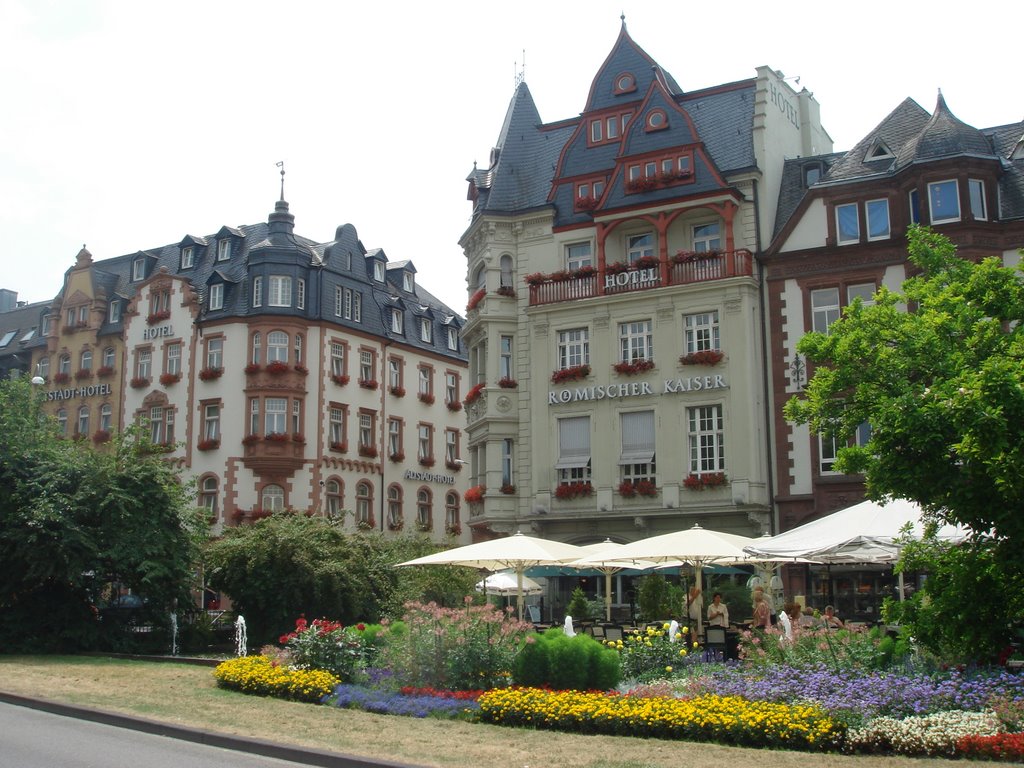
The train ride from Koblenz to Trier (Koblenz is a bit to the south of Köln, from where the train ride actually started) was mostly flanking the beautiful Mosel (Moselle) river. It would've been delightful to bike along the river (it meanders too much to make it part of a long-distance-I'm-behind-schedule-and-in-a-hurry bike trip like this one, but it would be perfect for a relaxing week of wine tasting and boating and little village sight-seeing), as you can see from some of the pictures with the pretty villages, etc.

Now what? Tomorrow after Trier I need to be headed for Berlin, and there are two possible ways to do this: head northeast towards Essen and Dortmund along the Ruhrgebiet and its Route der Industrie, of which Zollverein is just one stop, and which hits lots of former chemical factories and power plants and other interesting factory campuses (obviously very industrial, but flat and uncomplicated and through several sizeable cities--more comfortable stays and internet access guaranteed), or southeast through a multitude of hills and meandering rivers, smaller villages, a more roundabout route but with prettier landscape and what looks like more things to see (looks like may hit more UNESCO WH sites as well, though those could be reached from up north as well relatively easily by train if necessary)?

Arrived in Trier with such preoccupations in the back of my mind, which I shelved in the back-burner as I visited its nice Cathedral and the Basilica (now a Protestant church) which also used to be the throne room of Constantine, as well as its various Roman ruins which make Trier a UNESCO World Heritage Site.

Trier, by the way, was also the birthplace of Karl Marx, so they named a street after him and turned his house into a museum. Towards the end of the day and with nothing much else left to do or see (a stroll up and down between bridges across the Mosel was pretty but lonely), I wondered whether to take the time to visit it.

Now, I don't know much about "Capital". It is supposed to be a very good book with some rather sharp and careful analysis of 19th century economics, but I haven't read it yet (though it is right at the top of my reading list as soon as I finish with A. Smith), so I can't comment. But his and Engel's "Communist Manifesto" reads like it was written by two dancing monks on crack, so I decided instead to head towards the city center and spend the rest of the day before my return to Köln engaged in some very capitalistic window-shopping.

Ha ha. One friend of mine would be proud. ;)

Friday, July 21, 2006


Essen.

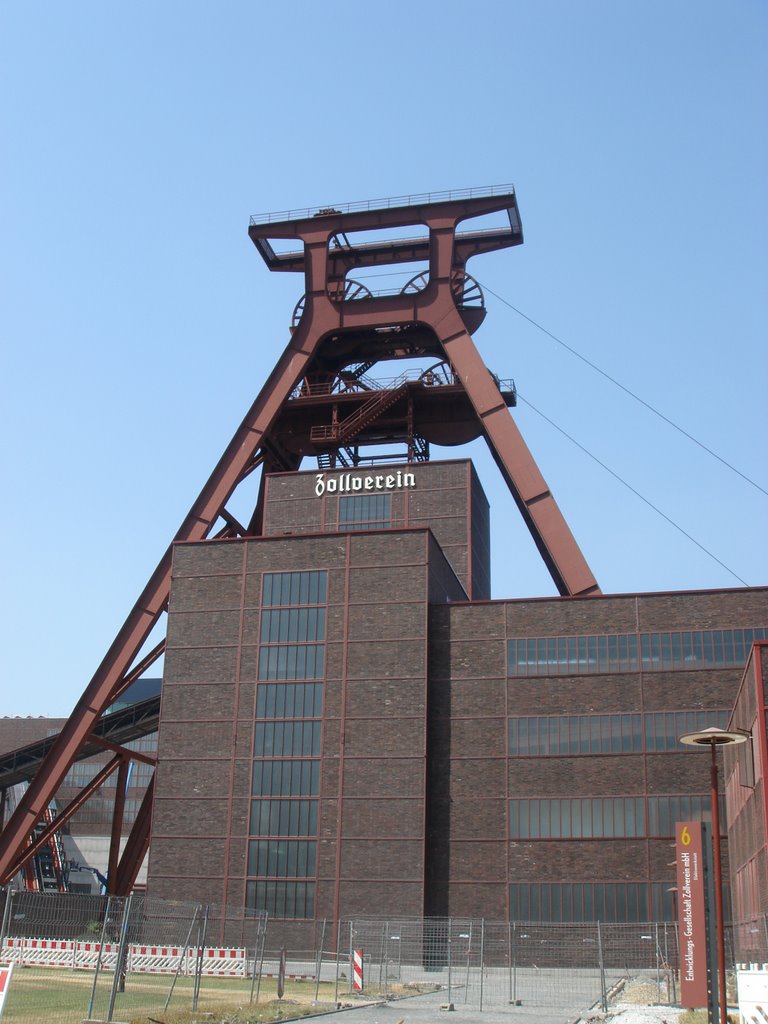
Visited the industrial complex of Zollverein at Essen today (why? UNESCO World Heritage Site!). This is basically a coal mining shaft (shaft XII, to be precise) and its auxilliary complexes, including the coal track cart repair shop, coal sorters, steam boilers, etc. You can't go down the shaft, but most of the Bauhaus-style complex you can tour around with a guide, and the rest of the buildings have been converted into things like a restaurant, a museum housing the Red Dot Design Awards winners, a casino, etc. Essen is otherwise not particularly interesting, so I didn't spend much time there, but I do have a rather interesting/funny/curious little anecdote to tell that illustrates what I thought was a....peculiarity in the German "character":

I was buying the entrance ticket to the Red Dot Museum exhibit, when one of the two college-aged girls staffing the ticket counter saw my Lonely Planet Germany guide (yeah, I finally ditched the Let's Go after the Germany guide a friend kindly sent me to Poste Restante in Reims from the U.S. did not arrive in time for me to pick it up--sign from the Gods of course that I was finally released from my "penitence chain", so to speak, a la "The Mission" movie--remember the scene where Robert de Niro after much pain and suffering finally loses the heavy net of stones and armors he was carrying as penitence while climbing up a mountain? Yeah, it was kind of like that, but anyway....) and asked politely if she could borrow it for a second.

Naturally, I said "Of course!" and handed the book over, at which point she immediately turned to the index and started looking purposefully for something.

When I finished purchasing the ticket from the other girl at the ticket counter, I turned to check to see if she was done with the book, but seeing that she wasn't I just kind of hung patiently around by the counter, until suddenly, in seeing that her friend was still carefully leafing through the book, the girl I had just purchased my ticket from turned to me and asked me, if I would like to leave the book at the counter while I went and looked at the exhibit.

I was a bit puzzled at this, and thought that perhaps I had misheard or misunderstood my German, because the immediate reaction was to wonder, why would I want to leave my book here, unless it was forbidden for some reason to take it with me?

So I politely asked if she could repeat what she said.

There it was again. "Möchten Sie", "would you like to". I had not misheard. She clearly said, and then the first girl looked up from my book enthusiastically nodding and seconding the first girl: "Would you like to leave your book here while you take a look at the exhibit?"

I paused while I puzzled this out for a minute. And then it hit me. Of course! Got it! I then replied with a polite (and amused at the sudden comprehension!) smile: "Ja, natürlich! Ich werde gern mein Buch hier lassen. Vielen Dank!" ("Yes, of course! I'll be happy to leave my book here. Thank you!")

In my country, of course, the same intent from the girls would've been conveyed, instead, with a more direct:

"May I please borrow your book a little longer, while you visit the exhibit, perhaps?"

To which I would've again replied: "Of course! No worries. Take your time."

But I thought it was kind of interesting, that while in France they make sure to make you feel like it was their pleasure when they do you a favor, turning the tables on your asking them for something in such a charming way, here the tables were turned but in the opposite direction: the phrasing was such that it seemed intended to make it look like they were doing me the favor of keeping the book for me while I looked at the exhibit, instead of the other way around (surely everyone must know how one tends to loathe parting from one's posessions--books, in particular, for me--if even temporarily, so doing so is a bit of a minor sacrifice on one's part).

I have, of course, not been long enough in Germany to be able to generalize about such things, or to know whether this was just ackward phrasing from still relatively immature 20-year olds, or whether it was just a peculiarity of the language and an ackward mistranslation (though the "Möchten Sie", I'm positive, was there. Twice) or whether there is a certain, shall we say...reluctance to directly ask for favors or help here. Perhaps the customs are such that one simply offers their help when it appears that someone could use it, and directly asking for it is impolite. Perhaps, it was I who should've offered to leave the book, upon seeing that the girl was not done with it, according to local customs. I don't know. Perhaps some of the Germans on the board can comment (Ralf or Torsten, care to give it a shot?), but the point is, it was a bit curious, and funny, and unexpected, and something to keep fresh in mind, for comparison and experience purposes.

Anyway, later in the afternoon as I was waiting for the train back to Köln I popped over to the Alte Synagoge in downtown Essen, which is I believe one of the largest (if not actually the largest) pre-war synagogues preserved in Germany. The synagogue was hosting an exhibit on Jewish life before the war, which I really wanted to see, but unfortunately I was a bit put off the exhibit by what appeared to be some rather...uh...biassed...descriptions of the displays. Here's an example (textual quote):

"The centuries old Christian anti-Judaism advanced in both the conscious and subconscious has easily evolved and transformed into hatred against the Jews."

or another:

"Christian anti-Judaism is based upon passages in the New Testament and it is incorporated in the writings of Church Fathers."

And no, my friends, this is not language mistranslation because:
1. The English I am quoting is word for word textual from the exhibit display letterings, and
2. The German is just as bad (if you want the word for word text so you can compare, just go ahead and email me and I'll send you the quote).

As if this "Jewish hatred" was intrinsically a Christian thing (because no other group has ever exhibited anti-Semitism before or since, right?). Or as if being Christian pre-disposed you to this kind of hatred. Or as if it were a characteristic intrinsic in Christian teachings.

They were surprising and obnoxious statements I did not expect. How disappointing. And how sad, too, that in trying to illustrate something about Jewish life and culture, by generously opening up an important worship place like a Synagogue to visitors (including those of other faiths), that is, in trying to erradicate ignorance and misinformation, showed a clear ignorance and effectively disseminated misinformation on the culture and teachings and customs of the group they were accusing of this hatred. For any flavor of Christian will tell you (be they Catholic, Protestant, or whatever, it doesn't matter, they all agree on this one) that any kind of "hatred" goes against the whole point of the Christian message, and the problem is, a non-Christian visitor to this exhibit, if not knowing this, may come to...shall we say...."inaccurate" (to put it mildly, for "dangerous" could've been a word that would've served just as well here) conclusions about Christians as well.

This kind of carelessness rather ruined things for me and made me from then on (the quotes above come within the first one or two displays, so the effect is immediate) take on a very highly skeptical demeanor at the rest of the exhibit, an added effect, surely, that the creators of the exhibit most likely did not intend.

Perhaps one day, especially when dealing with such sensitive issues, we may try to be a bit more careful, so as not to induce in the ones we're trying to communicate things to, the exact opposite reaction and resistance to understanding that we are most desperately trying to convey and repair.

:|

Thursday, July 20, 2006


Köln

Oh boy, the weather was as hot as a skimpy-clothed supermodel today. It was an effort just to move. So I didn't really do much today, I'm afraid.

Ran some errands.

Did laundry.

Saw the impressive Köln Cathedral, which as you can see from the pictures is jaw-droppingly beautiful. I think I've never seen something so neat before (and believe me by now I've seen my share of famous cathedrals), and I think this cathedral rivals, in my opinion, even St. Peter's in Rome (not in size, of course, but in beauty). What makes things even cooler about this cathedral is that, not only is it in the Gothic style, which gives it an imposing, mysterious, and intimidating feel, even (kind of cool for effect, given it is a Catholic Church building!), but the fact that they haven't really bothered to clean it up and it looks dark from the (what I think must be) smog stains gives it a very eerie "Gotham City" feel. I just love walking by the Domplatz of Köln at night.

I won't give you a blurb about the Cathedral this time. You can take a look for yourself here (but be sure to click on the picture above for a video of the Domplatz at dusktime taken yesterday by yours truly).

Wednesday, July 19, 2006


Aachen-Köln.

Trip dist: 81 kms. Trip time: 4 hrs, 37 min. Tot dist: 4,104 kms.

Ooooh. Oh my God. If this is a dream, please don´t wake me!

Welcome to civilization. These guys have bike lanes everywhere! But I'm getting ahead of myself. Let me start from the beginning.

Decided to head for Köln today instead of day-tripping to Trier as promised, since all trains to Trier from Aachen go through Cologne anyway and I'm also supposed to be headed there next. But first, and since Köln is biking close to Aachen (the map said 60 kms, but of course this is measured on the Autobahns, biking through national roads and bike lanes adds some kilometers, as you can see) and would not take the whole day I visited the UNESCO WHS Cathedral, on the site of Charlemagne's imperial dwellings, in the morning (the only part of the cathedral you can visit today is the Palatine Chapel, which is rather tiny, but very beautiful in the Byzantine style), where I learned two interesting things:

1. Aachen's (aka Aix-La-Chapelle in French, or Aquisgrana in Italian!) Cathedral was the first German site to be included in the UNESCO World Heritage List, back in 1978.

2. Charlemagne was born in Herstal! Remember? It is that tiny little village near Liége I passed by as I was getting lost on my way to Aachen just two days ago. Neat huh? Had I not gotten lost I would've never been able to say: "Hey, I've been to Charlemagne's birthplace, have you?" (and given it is such a tiny featureless village--or Liège neighborhood/suburb now, perhaps more properly--no one would ever really want to visit as a tourist, I bet not many people outside of Belgium have been there in the first place, so they are worthwhile bragging rights, you see...)

So maybe the bad luck/unpleasant things that happen to us are not really what we think they are in hindsight, you see... ;)

Anyway, one of the cool things about Aachen (and maybe Germany, but ask me later when I have had more time here to confirm the "first impression") that I've already had occasion to find out in just my this short stay is that things are very well organized here. The info booklets that you get at the entrance of Aachen's Cathedral Treasury museum, for instance, don't just describe what you're seeing (which in other guide pamphlets is usually a rather obvious and useless explanation, a la "Oh, this is a golden reliquary inlaid with figurines of ivory depicting the crucifixion", which are things you can observe for yourself with a quick glance and don't need to be told about), but it gives you an extensive historical blurb. The guide to the treasures, for instance, begins with a biography of Charlemagne and includes hand-drawings of the most important showcased pieces, including how they were made, how they were used, and why.

Take a look at the locks, for instance. They were used to lock away relics, but see the big glop of lead on the keyhole? (if you can't download the movie you can take a look at the picture here--hint, the glop of lead is easiest to see on the leftmost bottom lock) You see, once the relic was locked away, the key was divided in two, one going to the city authorities and the other remaining in custody at the Cathedral. The keyhole was then filled with melted lead to ensure that the relics would be kept under seal for 7 years, according to tradition mandates. Neat, huh?

Anyway, arrived finally into Köln, where, as I said, suddenly civilization hits you: bike lanes everywhere, and they are done correctly, that is, purposefully separated and shielded from traffic (see for instance, an example here), and with its own set of traffic lights once you get inside the city.

Approaching Köln reminded me a bit of my city of Guadalajara, near the area of the Calle Morelos, where, coincidentally, my piano teacher from the old Music School used to live, and who, by the way, currently lives somewhere in the neighborhood of Karlsruhe, a bit to the south of here. Wish I had her number, but perhaps a postcard wouldn't be such a bad idea letting her know I'm still alive after all these years...;P

Funny, Köln also reminded me a bit of Lyon, with its futuristic-looking tram cars and city bike rentals. I think I forgot to tell you, but in Lyon (and here in Köln as well, it looks like), you can pick up a bike at one of the bike stations interspersed in the city, then ride it for as long as you want, then return it at another station (for a video of how this is done take a look here). I think in Germany you phone up somewhere instead of paying at the stations (i.e. there are no automated stations here that I saw), but the concept is similar, of course.

Heh, there are also lots of very good-looking people here (not just males). Seriously, it looks like every 3rd person just popped out of a magazine. Dreaming? Nope, looks pretty real...

And, guess what? The tickets to the Philharmonic cost between 5-27 Euros here! Do you know what it means, when the most expensive seat at the Philharmonic costs only 27 Euros (that's about 4 times cheaper than what it costs in San Francisco, for you folks that don't live there)?! Do you?

It means, that if I lived here, I could go listen to the Philharmonic every day!

Tuesday, July 18, 2006


Liège-Aachen.

Trip dist: 51 kms. Trip time: 3 hrs, 26 min. Tot dist: 4,023 kms.

Celebrations IV.

Hmm...would've liked to have arrived here yesterday. Then the 4000th kilometer would've come very close to being right after crossing the border (no such luck due to the 30 km roundabout of yesterday), and it would've coincided with my brother's birthday, this last one, I think, a sign from the gods, and therefore a fine opportunity to send him a special gift (and hopefully he'll think to bring a bike along!).

Anway, the ride was all uphill, but pretty, especially Belgium right after Liège (Liège iself is very industrial and not particularly picturesque, in fact, it ails with all the ills of any modern city, and the industrial feel and the red brick 3-story houses reminded me a lot of Bristol. I don't think I'd like to live here), because what happens is that you climb up a hill chain, and then ride along the ridge, so that you can see the fields and villages below on the left (north) side, and the sea of green of the other fields on the right (south) side (for a quick movie panorama check here).

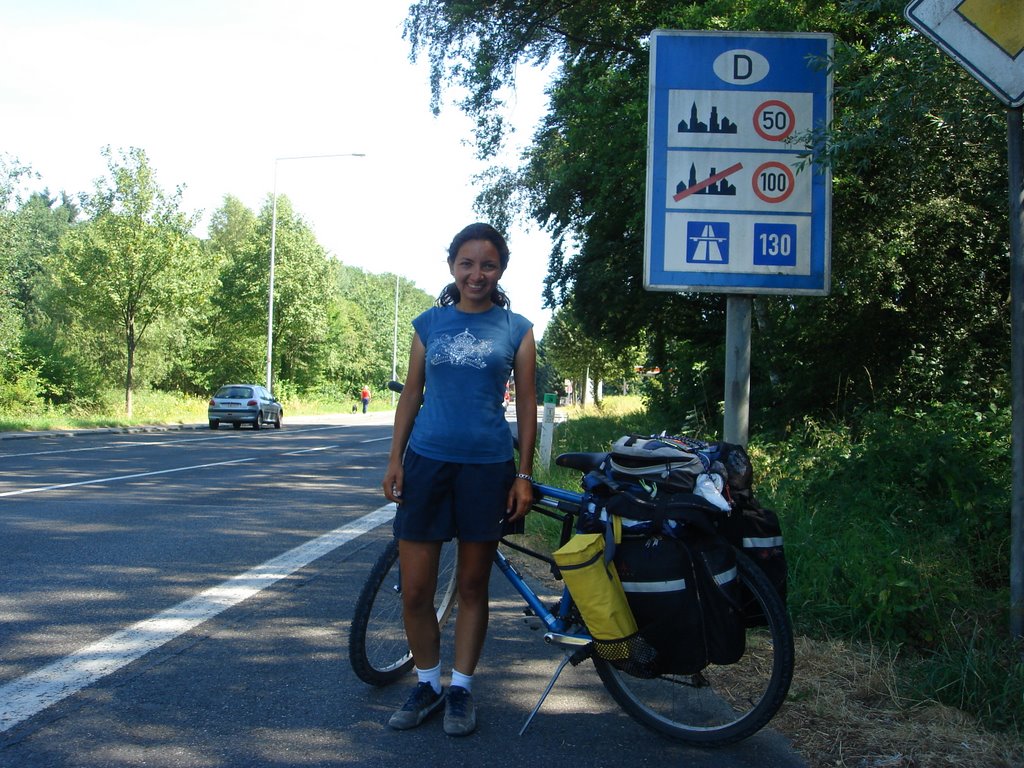
And, as you can tell from the picture above (again taken approx 1 km inside the new country), I couldn't find border crossing indications today, either. That's a good thing, though, right? One Europe and all that. Harmony and brotherhood blah blah blah, etc? The only way I could tell I was in Germany was that suddenly all the restaurant signs were in German and no longer in French.

Funny, I think whenever one learns new languages after you're about 16 or so, they end up being stored in the same "section" in the brain. When learning French for this trip, for instance, I kept trying to conjugate the verbs in German, but by now I've grown comfortable enough with French that by the time I got to the Youth Hostel in Aachen I kept trying to ask for things in French instead, even though my German, after having studied it for 2 years in University and having worked for over 2 months in Switzerland, is perfectly good enough for simple things like that. The cute receptionist was a sweetie, simply smiling discreetly whenever I said: "S'il vous pl...er, Bitte." or "Oui, nein, Ja!", while my head kept screaming at me: "Es ist auf Deutsch, du Dummkopf!".

Funny, too, clearly I'm thinking things in French first as well (not in Spanish or English or my other native tongue, all of which are, of course, far more fluent and were the base languages from which both French and German were learned), for at the tourist office when I asked for a city plan and the location of the nearest internet cafes in German (or what I thought was decent German), in spite of my desperate efforts to get my brain to "switch" languages once and for all, some word or another must've crept in, a random "oui" here, or a distracted "merci", or "plan de la ville" instead of "Stadtkarte", for after patiently listening to me, the tourist office clerk promptly came back with a city guide for me....in French.

Ha ha!

:)

Monday, July 17, 2006


Phillippeville-Namur-Huy-Liège.

Trip dist: 147 kms. Trip time: 8 hrs, 25 min. Tot dist: 3,972 kms.

Blech. I screwed up. I could've headed for Aachen via Amiens and Brussels (i.e. head north after Paris instead of northeast to Reims), and would've that way seen more UNESCO World Heritage sites (Brussels by itself already has two of them!), but I stupidly wasn't really looking at the map that far enough ahead (I only tend to plan the route at most 3 or 4 days in advance, and by the time I left for Reims I was convinced I was headed for Trier, not Aachen, first). Unfortunately from Phillippeville to Brussells it is already about 110 kms away, too far to bike without significant time impact. Oh well, like in Portugal, where I left off Guimãraes, on the way north from Porto and an easy addition to the route, but I hadn't marked it on my map as a WHS and ended up missing it until I realized my mistake when I was already somewhere in northern Galicia, this at least gives me a good excuse to come back. Right? {sigh}. I hate it when I'm stupid in these kinds of easily-avoidable ways. Oh well.

I found a great radio station on the radio, Dutch, I think, which was playing some excellent world music: everything from the Jackson 5 to Amalia Rodrigues to Reggae and everything in-between (including, can you believe it?! Yodeling! Ha ha!). It was good company. {shrug}. At least until I got tired of the yodeling. ;)


Hmm....I think Belgium must've been razed almost to the ground in the last war...even in the most recondite little towns it seems like reconstruction went on well into the 1970's, judging from the style of buildings and modern layouts they have. It does give them a very clean and efficient look, though.

Anyway, I wanted to get to Aachen today, but I didn't have a Belgium map (up until 9:00 a.m. yesterday I was rather convinced I was going to go to Trier via Luxembourg, but finally decided to save a day instead--day trip to Trier from Köln, that is---and figured that since I was only going to be in Belgium for a day or two, the road indicators would suffice to get me out of there. Tiny country, right? No map needed, right? Wrong), which resulted in a 30 km mistake in the neighborhood of Liége, a not-so-scenic roundabout with not only no forward progress, but actually backward progress instead (not even "stay put" waste of time, that is) that served as memento, to wit: "Elisa, you get what you deserve, and this is what you get for being an idiot."

I arrived in Liége, you see, right on time at 5 p.m. (plenty of time to spare for the 55 remaining kilometers to Aachen), but headed off in the wrong direction after asking in horrible French (my fault on that one) to people who instead of admitting they did not know they invented an answer, and I ended up in the teeny weeny town of Herstal, way up north and on the wrong side of the river, in direction of Maastricht, not Germany, and by the time I sorted out a map (that is, bought one, finally admitting defeat after running around in circles callejeando through lots of towns I should've never even ever come to hear of) and figured out the directions to correct the mistake it was already 6:30 p.m. and I was 15 kms north of the correct highway (somewhere between Cherate and Visé, that is, for you map fiends, whereas the correct highway was supposed to be the N3, which you catch by riding southeast from Liège).....with a huge steep hill in-between. Not good. (Hill not doable, much less in the time available--required imperative pushwalk, judging by the grade, at least 12% by eye estimate) Had to return to Liège and stay there. Oh well. Lesson learned: Buy your maps, kids.

The internet is cheap here (lots of things, except hotels, seem cheaper, even soft drinks at shops and bars), only 60 cents per hour! This is even cheaper than Portugal! At the Youth Hostel, of course, they charge everything at four times the cost (which is ironic, since you'd expect they'd try to cut the non-working, parent money dependent youths a break or two), but even here it is only 1 Euro and 60 cents an hour (cheaper than Spain let alone France). Must be that the internet is ubiquitious here.

Oh, by the way, guess what I figured out during my trip today? The word "restaurant", it comes from restorer, to restore! I had never really thought about it until I saw the signs here that said "Restauration rapide" or variants thereof outside the diners. Neat huh?

Belgium is so pretty, all red brick.

:)

Sunday, July 16, 2006


Reims-Rethel-Rocroi-Couvin-Phillippeville.

Trip dist: 143 kms. Trip time: 9 hrs, 30 min. Tot dist: 3,825 kms.

Ho, folks. Check it out. This is THE perfect bike road: flat, no curves, wind in favor allows you to bike at 30 kms/hr, nice flower-filled countryside, no cars, and approaching a pretty village. What more could a girl want?

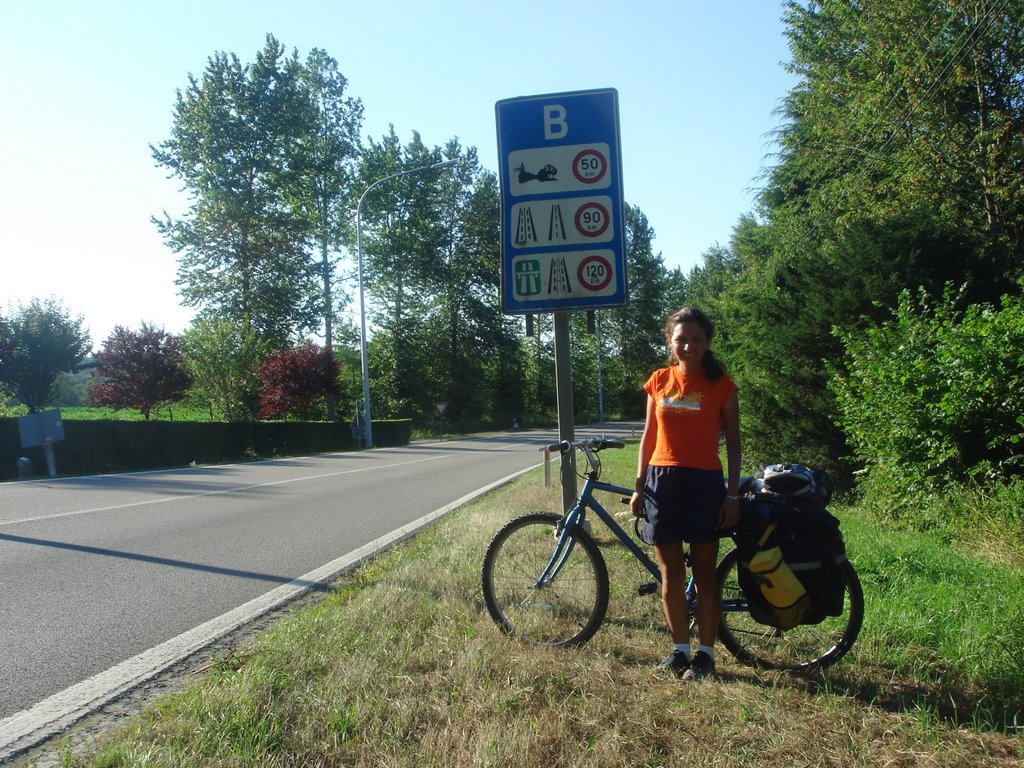
Crossing the border into Belgium was....indeterminate (I decided to skip Luxembourg and Trier to save a day--I'm already seriously behind schedule for Istanbul and Trier can easily be reached by train for a day trip from Köln). The map says that Belgium starts right at the end of the town Guè de Hossus, but there were no signs alerting me to the fact I had changed countries. The confirmation came in a rather curious manner. As I was posing for the traditional border-crossing pictures (these are at the real border, the picture you see above this post, on the other hand, was taken already 1 km inside of Belgium), I got an SMS message from the mobile phone carrier, alerting me that coverage was switching from SFR (the French service provider), to PROXIMUS (the Belgian service provider), and informing me what the roaming charges were.

Scary, how technology pursues us, and oftentimes knows more about us than we....

The two videos of the old downtown square that you see in today's movie folder that look so similar are not a case of dèjá vu, Rocroi (in France) and Phillippeville (in Belgium) are simply two fortified cities, so they are both laid down as impeccable pentagons with bastions, and the city plans of one and the other are practically interchangeable!

Anyway, from the very little I have seen of Belgium so far it would appear that the people here are rather well off economically (I cannot say the same thing overall for France, especially in the small towns and villages--even the ones that get lost of tourists and with them, one would expect, a significant influx of money): here in Phillippeville (pop. about 7,000) for instance all residential buildings are 2 or 3-story houses, all red brick and all of them very elegantly furnished in wood and leather (yup, could see through the windows ;) ), the cars are all less than a couple of years old, big, and very clean and well maintained, etc. And this is just in a tiny little middle-of-nowhere town!

Not much else to say for today, except that I'm rather looking forward to Aachen, a town that right at the border straddles 3 different countries. Should be exciting.

Saturday, July 15, 2006


Reims/Epernay

So, I could've left France today, but decided to stay one day extra so that I could go to Epernay, even though as you know I'm not much of a oenophile and in particular I'm not a big fan of fizzy wines (don't ask me why, that's just the way it is!), because being in the Champagne region and not going to Epernay is a bit like having landed in Annaheim and not going to Disneyland. ;P

Anyway, Epernay, as expected, was not too exciting for a fizzy-wine resister like me, so I came back to Reims early and visited its UNESCO sites, including the Cathedral and its Palace du Tau, the bishop's residence and palace.

The Palace du Tau had some very interesting exhibits of the belongings of King Charles X, including spectacular royal mantels, crowns, necklaces, staffs, jewels, in sum, all kinds of sumptuous objects designed to mark and exalt one person above all the rest, as if they were somehow special, not because of who they were, or what they accomplished, or how they smiled or wrinkled their nose, even, but by luck and circumstance of birth.

Now, I won't go on here about how all people are equal, and how no one is of no more value than another, that every life is special, blah blah blah and so on and so forth. There have been too many things written about that already, and besides, that is a bit too obvious a segue, and I think by now you know me (I hope), much better than that.

What I did want to say, though, is that the day I find him he will be special and extraordinary and exalted above all others, not because of what he has, or what he gives me, or what he looks like, or what he has accomplished, even, but because I made him so, because it was I who chose him, because it was I who spent the time with him, because it was I who remembers him when he is away, because it is me who sees him when he walks in the room with a sunny crown around his hair, invisible to everyone else but me, and warms my heart with laughter so majestically every day just from knowing that I'll see him, because I made him, because it was I who gave him this "shininess" and extraordinary value, this thing that sets him apart and above all others: it is something that you can't just intrinsically have, you see, unless someone gives it to you.

Friday, July 14, 2006


Chateau-Thierry-Reims.

Trip dist: 69 kms. Trip time: 5 hrs, 17 min. Tot dist: 3,681 kms.

Hmmm...

Every time I'm about to cross into the next foreign country I get jittery. What worries me, exactly? Is it the unknown maps, that is, the fact that I don't know if the ones I bought will be accurate with the distances or elevations? Is it the unknown culture, the stress of knowing you will have to quickly adapt, ditch your pre-conceived notions of what things are supposed to be like, and most importantly forget all the "adaptations" you had to make to the current country, and learn the new ones as fast as possible? Is it wondering: will the people be friendly? Will I understand the language? Is it wondering about the actual bike routes chosen? Are there unfriendly lands or more dangerous roads than others? Also, the Western Germany border seems to have lots of forests, which apparently I need to cross through, not just pass around like in the other countries up to now. This doesn't sound bad, right? Except for the fact that the forests are national park type places, which means that they are scantily inhabited. While trees should fill me up with glee (canopy in hot summer!), it is actually rather eerie, for what do you do, all alone with no population for 20 kms, if something goes wrong?

Most of these things you can't know a-priori, especially if you don't have friends there you can call up and ask.

Which feels a bit lonely. All these questions, uncertainties, that you just have to face alone, you see.

But it all goes away, you see, eventually. Still, it always takes about a week inside the new country. Not sooner.

So one hangs on in the meantime, I guess. Cheerio. Right?

Nah. I get just as scared and stressed and worried as the next normal person, if not more. I'm just telling you,in case you thought even just for a second that this kind of travelling is all fun and easy. ;)


Route planning, too, is a bit confusing from here on. What now? If the next "goal city" is Cologne do I go through Luxembourg to Trier and then up northwards, and finally figure out what language the "Luxemburgians" really speak once and for all (;P), or do I go through Belgium to Aachen and then East from there: a shorter, more direct route, and leave Trier as a day trip from Cologne?

I don't know! I am anxious and confused. Luckily I've budgetted a day before border crossing for visiting Reims. Maybe I'll get it sorted out by then.

The Youth Hostel here in Reims, by the way, is delightful: spacious, full of light and lots of amenities (internet, ping pong, two or three lounges with TV, laundry, etc), and pretty much empty, too! It reminds me a bit of Baker House or Next House back at MIT. So there's also a bit of nostalgia coming from this as well.

The ride to Reims was also/again very pretty but very tough (see the long amount of time it took me to travel the short 70 kms!), uphill overall, plus the dreaded z-direction (unnecessary?) sinusoids, and with strong headwinds. All 3 tough situations combined in 1 ride. Uuuygh.

It was also a rather frustrating day: the internet cafe was closed by 8 p.m. (the one at the hostel is only good for short visits and not worth using for serious time consuming business), the credit card seems not to work, there are no people on the streets in the city of Reims.

Maybe, tomorrow will be better.

Thursday, July 13, 2006


Paris-Meaux-Château-Thierry.

Trip dist: 100 kms. Trip time: 6 hrs, 45 min. Tot dist: 3,613 kms.

So, here in France, the 14th of July is Bastille Day. Celebrations are equivalent in importance to the U.S.'s 4th of July, pretty much, and they start from several days before, including, in particular, the decorating of city building façades in the traditional red, white, and blue of the French flag, the cleaning up of the Champs Elysees, and the organizing of spectacular fireworks shows in picturesque cities such as the medieval old town of Carcassonne.

But one of the neatest things associated with this National holiday, as Dorothee pointed out to me the other day, is the yearly Firemen's ball. Every year on the night of the 13th, each local firehouse (and its multitude of handsome, available, single firemen gentlemen) organizes a ball to which pretty much anyone is invited.

I really wish they had had something like that in Mexico or the U.S. Imagine that. This would be the closest thing to simple "comparison-shopping for a boyfriend at the boyfriend specialty store". Any girl's dream. :)


The ride from Paris to Château-Thierry was very pretty, especially the section from La Fertè-Sous-Jouarre to Château-Thierry on the N3, but it was rather strenuous and with lots of tough hills. I actually wanted to arrive to Reims today, but

1. I had to wait for the silly credit card, which luckily arrived as promised but it means that I did not leave the hostel before 10 a.m. and

2. I wanted to take a last-minute picture of the Eiffel tower for posterity (the picture you see in the post from the 4th of July was actually taken today. Yeah, my pictures time-travelled for this one. So sue me), since I hadn't bothered to take one during my several days' stay here before.

So that (and the multitude of hills) rather made arriving into Reims a bit difficult.

Speaking of hills, that reminds me, during the ride, shortly before arriving into Chateau-Thierry, as I was climbing one of them (tough and strenuous time requiring all of my concentration and which tends to create, due to the effort, a not very benevolent nor patient mood in the typical rider, myself included), a car honked at me just as it passed rather close to me. I tend to find such things rather annoying, because a loud unexpected honk tends to rattle you a bit, makes you wobble the bike, and can be rather dangerous in non-flat terrain (on downhills, because you're going so fast that a wobble can mean a dangerous high-speed skid and fall, and on uphills, because a wobble may make you lose your balance on a slow bike such that you need to step off it, possibly into the main road or unto the uneven shoulder, both options not apetizing if there are other oncoming cars in the first case or if the shoulder is at a lower level relative to the main road). In fact I once met someone who ended up in the hospital with serious burns and scrapes after a truck had honked in passing, not touching the rider, of course, but simply throwing her off balance, with very nasty results (not finishing the race was the most benevolent one of them, as a quick glance to her badly scraped arms and legs had shown). So, not a good thing, and the reaction at this, of course, had immediately started to be one of great annoyance, especially when not more than a second or two later I saw someone from the passanger's seat of the car in question throw something round and bright pink and that looked very much like a used balled-up napkin towards the side of the road just missing me and landing about 10 meters in front of where I was riding. Yes, I had even heard stories of other riders being greeted with rocks pelted at them from people on the streets in some countries, and the anger at the supposition that something looking very much like garbage had just been thrown at me overwhelmed the incredulity that these kinds of things could happen anywhere in Europe, let alone France.

But as I neared the spot where the thing landed, the anger dissolved quickly from my face, and I couldn't help grinning as I delicately picked up the object that had been at me so purposefully directed:

It was a rose.

Wednesday, July 12, 2006


Provins.

Romantic emergency? Forgot that your girlfriend was arriving on the 2 o'clock train? Don´t worry, for these kinds of situations, all you need is to head over to the nearest flower vending machine, and your problem is solved!

Who knew that the French were so romantic AND practical at the same time! :)

Anyway, today I spent a fair amount of time sorting out some credit card troubles. Since I had lost my wallet in Spain I had done without it, and did not get a replacement because of the difficulty of finding a more or less "permanent-like" address where the replacement could be sent (I still fondly recall the nightmares when the bank card was to be delivered). But with friends in Paris I had asked the credit card company to send a replacement to Edwin's apartment, and it had not yet arrived. As it turns out, it was in France, at their delivery center about 20 kms away from the city, but it could not be delivered in the morning due to some building access code confusion, and someone from the credit card company had requested that if no delivery to please send the card back to the U.S.

Naturally, this would've been a bad thing. So long as the card remained in France, I may pick it up, but if it went back to the U.S., no chance at least for a few more weeks, and then some stress to boot.

Well, French customer service (I had to call the customer service for UPS, which was the company delivering my letter containing the card) is just as inefficient as American one, but at least here they're more polite about it. For one thing, they genuinely seem to care, and additionally since calling customer service numbers here runs you about 10 Euro cents a minute (it is like calling a 900 number in the U.S.!), when they see that the call is going to take a long time instead of putting you on hold they ask you for your number so that *they* can call you back (and they always call you back with the resolution within the hour!).

Which is fine and dandy, except that today I forgot my cell phone in the hostel, and I was calling up customer service from the train station on the way to teeny weeny UNESCO World Heritage Site medieval town of Provins.

Blech. Big mess. The final scoop: they will attempt to deliver tomorrow again. Hopefully this will happen before I leave (I ride away from Paris tomorrow, as I am already way over schedule), as I do not want to start riding after 10 a.m. considering the length of the next stage.

Provins: o.k. town, not particularly exciting (or maybe I'm simply starting to get tired of all these European tiny medieval towns, or the heat is shortening my patience for them, at any rate), saw their ramparts and their underground galleries that served as hospital and refuge for pilgrims and beggars, missed (on purpose) the tourist shows of joust re-creations and birds of prey exhibit, but mostly spent most of the time in busses and trains and waiting for the connections (tiny towns are a bit like that---connections don't happen very frequently).

Upon returning to Paris, though, I took the afternoon to see the rest of the city that I hadn't seen in the previous days, including what I stupidly and regrettably had left for last: the area of Montmartre.

Most of Paris, you see, is a bit like Milano or New York or any other big city--fast-paced and chaotic, big buildings and traffic and people busily going somewhere important, and nothing too exotic or exciting, really (other than the museums and a spread out building or area here or there). I was telling Dorothee and Edwin just a few days ago, in fact, that Paris is not at all like the movies, that it is not at all that romantic, oblique-lighted beautiful bridge and fog and umbrellas in the Champs Elysees that you see in the paintings sold at the shops, no, just a normal city, in fact.

But I had spoken too soon, you see, for here in Montmartre, it is!!

Even in spite of all the tourists, Montmartre is a quiet little haven a little bit like the area over near the Coit Tower or the Upper Richmond district in San Francisco. If I ever were to live in Paris, it would have to be here, no other place would do (though I'm sure the rents here are outrageous!). I really wish I could've spent more time wandering Montmartre's streets and hanging out at its cafe's and enjoying the views of Paris down below, but regrettably I left it for rather late (But I blame the Let's Go for not emphasizing this neighborhood properly!), which was a real pity.


{sigh}. So, how does a girl spend her last night in Paris? Atop the Eiffel Tower for an unparalleled nighttime view of the city? A kiss with a handsome gentleman on Pont Neuf as the sun sets over the waters of the Seine? A visit to the stratospherically expensive and extravagant cabaret show at the Moulin Rouge? A dinner in one of Paris' finest restaurants?

Ah.

What I did in the end I'm keeping to myself. :).

What I will tell you is that it was nice, and mysterious, and surprising, and interesting, and exciting, and scary, and funny, and....lots of many other things.

But that's as far as the details go.

:)

Tuesday, July 11, 2006


Orlèans.

Hmm...Orlèans was not too exciting. It has a pretty cathedral, but that's about it. I arrived there at 1 p.m., and was ready to leave by 2 p.m., but had to wait for the train at 4:30, so quite a bit of "time killed", or rather "compelled to murder" there.

Met up with Dorothee for coffee upon the return. She had a couple of days ago offered to give me a tour of the hospital where she works as a CRA (clinical research associate), which is no less than the Hôpital de la Salpêtriére, one of the best known and reputed hospitals in the field of Neurology in Europe.

Now, this hospital is not only famous due to the work and pioneering research that went on (and still goes on) there, but also as a historical building, with its famous chapel by the same architect (Liberal Bruant) who built Les Invalides, a group of buildings in the 7th arrondissment here in Paris. In preparation for my visit, Dorothee had most kindly spent a fair chunk of her free time reading up on its history and architecture, going as far as asking the people who had worked there for many years, what were some of the hospital complex's curious anecdotes and "secrets". In fact, she told me that when she told her boss that she was to show me around that afternoon, her boss even gave her an article about the hospital's history that he had written himself, so that she could give it to me (an electronic copy of the article can be found here).

Dorothee did, of course, a most wonderful job of showing me around and recounting what she had read up on, and took the task so seriously, that she even promised to send me pictures of the beautiful chapel that we regretably couldn´t visit because it was closed. And I, I was most impressed that both she and her boss (who we ran into while Dorothee showed me around) had gone clearly out of their way to prepare for and showcase with pride and enthusiasm their place of work. It was a most enjoyable time, not only because I got to spend some time with a friend, but because the promenade was filled with a lot of insight and good humor, peppered with entertaining exchanges such as:

Dorothee [as we approach one of the hospital's buildings]: See this building here? It is where they kept the crazy women.

Me: Crazy women?

Dorothee: Yes, you know, professionals.

Me: Huh?

Dorothee: Yeah, how do you say in English....bitches?

Me: Er....

Dorothee: Is that how you say it, right? Professionals bitches?

Me: [Long pause]. Oh! Er, you mean, like, uh, "women of the night", kind of thing?

She: Night women? I think....maybe.

Me: Uh, prostitutes, you mean?

She: Yes! Exactly! Bitches, right?

Me [chuckles]: Er, no. That´s not quite how you say it.


And so on. Ha ha. :).

I really like Dorothee. I always laugh a lot when I'm around her.


Anyway the point is, that back in the 1700´s or so, prostitutes, promiscuous women, and so called "hysterical" women, were confined in the hospital and considered clinically insane (see Dr. Berlin's--Dorothee's boss'--article I mentioned above). Rather sad, as she pointed out. Good that eventually science triumphs over ignorance. {shrug}

Afterwards Dorothee and I went for drinks at a nearby coffee bar, where another funny exchange ensued:

Dorothee [ordering to waitress]: I'll have a Perrier with a drop of lemon syrup.

Me [after waitress leaves, jokingly]: You know, my friend Edwin says that Perrier with syrup is a thing for little children.
[It was true, he had said that when we were watching the France-Portugal game at Emilio´s a few days ago.]

Dorothee [gets all serious and frowns]: Well, yes, but I like it.

Me [laughing]: Yes, I see. [The Perrier and syrup in question had just arrived, and the look of delight in Dorothee's eyes was rather revealing!].

Dorothee: You see, it has to be lemon syrup. And it has to be Perrier. Only Perrier has the correct taste and....

Me: But with lemon syrup you can hardly taste the Perrier, or can you?

Dorothee: Yes but also only Perrier has the right size of bubbles, and I don´t know, only Perrier is right for these kinds of things. In short it just *has* to be Perrier.

Me [smiles knowingly--I feel the same about Lavazza coffee]: Of course.

:)

And I that had thought that maybe Dorothee was not really a Frenchwoman, when she had told me back in Barcelona, that she had a craving for one of those McDonald's soft-served ice-creams.

:D

Monday, July 10, 2006


Fontainebleau/Chartres.

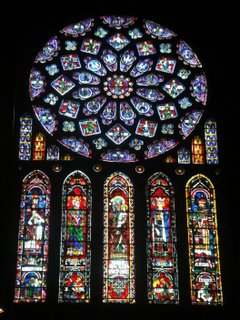
Visited Chartres Cathedral (UNESCO World Heritage Site) and its 176 12th-century stained glass windows (only the Cathedral at León had comparably as many). The huge cathedral dominates the sight as you approach from the train station (Chartres is a very pretty little town, by the way, and I theorize the reason for this is that it has lots of flowers), and it was a nice restful sojourn at the pews near the altar as I escaped the heat and rested from the morning´s visit to Fontainebleau.

I liked Fontainebleau much better than Versailles. It is a bit more "modern" in style (it was the palace of Napoleon III so the decor is brought up to 1800´s style in contrast with Versailles), but most importantly, it only has about 1/50th of the tourists.

And that, my friends, is why it is good to go to the UNESCO World Heritage Sites! They´re very pretty, and without the crowds.

Sunday, July 09, 2006


Versailles.

The other kind of freedom.

I went to Versailles in the morning in the hopes that I would be done by 1 or 2 p.m. in time to run to Fontainebleau in the afternoon, but I wasn't counting on the multitude of tourists who arrive by the trainload--literally. The train I was on was 99.9% full of tourists, and the line to buy the tickets was at least 500 people long.

Luckily, however, and contrary to my fears (I had estimated a 3 hour ticket line wait judging from previous experience at the Galleria degli Uffizi in Florence), the line moved (relatively) quickly and in about 1 hour I was finally at the entrance.

Now, Versailles is pretty, but I seem to remember seeing prettier things in Italy. And at the risk of sounding a bit overly patriotic, Italy is a work of art, a jewel. You stumble into a castle, a renaissance sculpture, the ruins of a Roman city at every corner, so much so that, as my two Italian Youth Hostel roommates pointed out to me this morning (they are from Rome), you can get an overdose of it and eventually even...find it boring. (I suppose it is also a little bit like Mexico: with the ruins of an old temple/pyramid under pretty much everything that looks like a hill with a slightly-flattened top, and when farmers routinely have to clear away vases and pottery figurines of pre-hispanic civilizations when plowing the land, you eventually get used to it a bit, and start to devalue it, which is a bit too bad).

So anyway, the point is, Versailles is fine, but nothing particularly special (at least not for the price of admission, including the 7 extra Euros you have to pay to to see the "musical waters", which basically means that they turn on the [rather ordinary] garden fountains for an hour or two at the same time that they broadcast some 18th century chamber music through loudspeakers scattered about the park). Still, it was kind of nice to see the pretty locations where all those 18th century style movies (you know, "Dangerous Liaisons", "The Man with the Iron Mask" and the like) were filmed. And interesting to see how the palace was a little bit like a modern university campus--it had all it needed there: lakes, hunting grounds, an opera, country Trianons for entertaining little trysts with a surreptitious lover, and what you did not have was simply brought to you at your command.

No wonder, then, that the kings and court were so disconnected from the world and their people. There was no reason to ever have to go anywhere, not to neighboring towns, let alone Paris with its (back then) filth and chaos.

But here, all protected and with every kind of artificial commodity simulating bucolic life, but never living it for real, I rather wonder, if the royals ever felt like prisoners.


The World Cup final, by the way, was today: Italy v.s. France. Another kind of freedom: being able to shout a loud "Evviva!!" when the last Italian penalty shot means the defeat and dashing of all French hopes for the trophy, in a cafe packed to the hilt with people whose silence at the slow motion repetition speaks in eloquent volume, and then having your hand shaken by a young gentleman next to you, who although visibly unhappy at the result without a trace of bitterness smiles and says to you: "Mademoiselle, congratulations."

Saturday, July 08, 2006


Paris, Day 4.

This morning I went to the Musee d'Orsay where I spent a fair amount of time on its 5th floor (impressionist painting wing, the other floors were not too exciting), where I discovered that I really like Paul Signac! (You can take a look at some of the painters and videos with commentary by yours truly here). I had seen his stuff up close in photos before, of course, but live is a lot better, because then you can really distinguish the details: his brushstrokes up close are very fine and yell defined, even more so than the rest of the pointillists'. Then, for instance, take his painting La Seine à Herblay. I counted no less than 4 different tones of white in that painting, pure and unblended (this kind of style allows no brushstroke or color blending anyway). Neat, huh?

And then, of course, you look at the painting from afar (see for instance here for an example, this one is by Maximilien Luce), and it looks totally different, like a photograph, even, you can't even tell it is pointillistic anymore.

What makes the pointillists so cool/impressive is not so much the "pixellation" of the picture (you already had that centuries before with mosaics or pictures on tapestries, for instance), but the use of color, which like other impressionists finds surprising tones in unexpected places: reds in depictions of water, orange in grass pastures, green in people's faces, for instance, and the very bright colors combined with the very sharply-defined brushstrokes give it a nice "precision" feel that as an engineer I find very elegant and aesthetically pleasing. {shrug}.

You know, seeing all these super cool paintings almost made me want to try painting something also! Which is a great reason to bring kids to as many museums, archaeological sites, monuments, libraries, etc. and get them to travel as much as possible in general. That way, they become inspired and see more possibilities for what they could do and become than what they may encounter only at home or in school.

Friday, July 07, 2006


Paris, Day 3.

Strolled over to Montparnasse today, which took the greater part of the morning, because Paris looks small and walkable on the map, but is actually a lot more extended in area than one would think. But I wanted to see the city, you see, it always looks so pretty in the movies, though so far, though clean and in some areas maybe even appealing, and though it has everything (shops of all kinds, nothing you cannot find here no mater how exotic), is after all simply just a big city, not much unlike, say, Milano, or New York, with its chaos and car honking and people in a hurry, and curiously people live and move around like in most large cities, only in small relatively confined areas by choice: there is no reason to go up to Bastille if you live in Montparnasse and vice-versa, when everything you need can be found one or at most two blocks down the corner.

Anyway, after finally arriving in Montparnasse and spending some time at the Librarie Gilbert-Jeaune, a pretty darn big 4 floor-bookstore whose entire basement was dedicated to travel books/guides and maps, to buy me a Germany road atlas in preparation for next week's arrival, I visited the mysterious Paris catacombs, containing no less than 5 million people (or bones of, that is) piled up in rows and rows and rows one on top of another about 1.5 meters high through a labyrinthine system of over 300 kms of subterranean tunnels (you only get to visit 1.7 kms of it, all full of bones without space for a pin between them and even arranged to make pretty patterns with the skulls) at 20 meters of depth (under the Paris Metro and sewer system) more or less following the organization of the streets above (I say more or less, because though that is what the guide said, Edwin claims that people have in the past gotten lost in there and forgotten for days...and to my reply--I had assumed he was kidding or at least exaggerating for the tourist me--that they simply should've brought a normal city map along, given what the guide had said, he got all serious and clarified that they often connect to other buildings and sewer systems and other underground systems that most definitely do not follow the city roads). Why no one (that I know of) has staged a good book or suspense movie here I don't know (if the Francophones here think I am mistaken and instead know of any books that are set here, let me know in the comments section, for would love to read a good story!), because the setting is absolutely ideal, what with the romance of the city above, the decadence and grimmness below, etc. etc. Some parts, even, I kid you not, reminded me a bit of the basements of MIT's buildings 66 and 54 (granted, MIT is a lot more brightly lighted, sort of), what with its cabinets full of bones and fossils that came from who knows where (believe it or not, MIT does have an anthropology and archaeology department--it even gets 2 or 3 students per year!) thrown in helter-skelter, and made me think for an instant that perhaps some of the MIT profs got from here the inspiration for their decor.

The catacombs, by the way, were originally limestone quarries, and were only turned into dead people deposits in something like 1786 or so to relieve the Les Halles district above from disease caused by unhygenic conditions in its nearby Cimitière des Innocents. So basically they exhumed everybody there and moved them down to the quarries, eventually extending the privilege on to other cemeteries as well. Icky, I know. But that is why the whole place is littered with signs alerting the tourists that this is consecrated ground and be respectful of the people who rest here and so on and so forth, even though it was someone (don't remember the name right now) later in the 1800s who had the bright idea to arrange the bones in piled up decorative patterns to save some space and open the network to visitors.

Anyway, all of those huesitos piled up and at length and oftentimes arranged rather comically and to no end made me think 2 things:

1. What a waste of calcium. I mean, there are people here from before 1768 here, whose families and descendants, probably, are also all dead by now and don't care to come to visit (bones are of course unmarked anyway). I mean, with so many bones, you could probably do something with all that surplus calcium (ironic that the catacombs used to be limestone deposits, eh?? Still are, in a way, ha ha!), I'm sure the spirits wouldn't mind. Why? Think of it this way, what "respect for the dead" and "reverence", and ceremony is there, when your bones are piled up at random with someone else's such that your hip bone connects to someone else's knee bone connected to someone else's humerus and your femur which should've been somewhere in the same area as your hip bone is actually 37 kms away supporting half a skull that like 6 or 7 anonymous others is arranged into a pretty cross and altar pattern for entertaining obnoxious tourists? What respect are they talking about? Might as well get rid of the "please be reverent" signs, I think. I mean, after all, your soul, if there is one (if you have one, ha ha!) is probably gone somewhere else by now, and if not, it is thanks to this system gnashing its teeth and spinning in its grave (or not, in this case). In which case, more reason to stage a good murder mystery here...

2. The sheer number of people that exist on this planet (or more properly, that existed). Yikes. Good thing the bones here are long dead. It must be horrifying to see an analogous fresher pile of so many anonymous dead put together. Only....this kind of anonymous piling still goes on as recently as to this day. For what reason, I never understood.

Anyway, an obnoxious thing happened to me as I was exiting. The guards/curators at the exit asked to see the plastic Gilbert-Jeaunne bag containing the Germany atlas I had just bought prior to the visit. Apparently tourists like to steal bones to keep as souvenirs! So they asked me to open the bag and show the contents. Nevermind that it clearly was not bulky enough to contain a bone, or that it, containing a large and thin, rectangular book did not have the appropriate shape, or that the bag in question was clearly labeled Gilbert-Jeaunnes which is a bookstore as well known and ubiquitious as Border's in the U.S., or that if I really were trying to steal bones I'd probably hide them in my other bag, the daybag I was carrying, which even has zippers and everything and which they did not ask to see.

Enclose the stupid bones behind glass then! Or use a bit more judgement. Why I looked like someone who would take home half the left hand metatarsal of some reeking damp icky old skeleton is beyond me.

Anyway, afterwards I was planning on visiting the Let's Go highly recommended Park Citroën, but ended up meeting up with Dorothee instead, who had just come back from Biarritz and as she lives close by right in Montparnasse it was a rather happy coincidence I was in the same general area. We had a nice evening chatting and catching up on the respective adventures since Barcelona and, as ever since the past few day's biking across green grass fields peppered with chamomile I had been having a craving for this kind of tea, some relaxing tea at her apartment. It was quite restful and pleasant. :)

Thursday, July 06, 2006


Paris, Day 2.

Visited the Louvre today. Wow. It is, I would say, about 3 or 4 times the size of the Met in New York. It spans a full city block, and has 4 levels. It has no less than 2 Metro stations servicing it (at opposite ends of the building) on the same line. So imagine the size.

Let me give you another idea: I arrived at around 10:30 a.m. at the opposite end from the entrance. By 11 a.m. I was inside (buying tickets is child's play and wastes no time as the tickets are vended by automated machines scattered all over the reception lobby under I.M. Pei's pyramid) and started walking the basement floor.

I came out at quarter to 6 p.m., just shortly before closing time. This was, without stopping to read the captions (one exception only--the captions at the stone of the code of Hammurabi. One's got to read the translations of the inscriptions on that one!)--the time was basically what it took to traverse the large block of buildings, four times, and the stairs, plus a small lunch/water break in-between, at a fairly energetic pace (or what could be construed as one after four floors and 7 hours of nonstop meandering!).

Incredible. Now, just as an exercise, with 35,000 works of incalculable value in terms of historical worth, execution talent, and culture, can you imagine for a second, what would be lost if someone dropped a bomb or a roof collapsed or even just one room or collection in the Louvre were otherwise destroyed?

Can you imagine the loss in the context for humanity? How much poorer would we be? When you lose something that has no price, not because its value in terms of materials or even raw labor is so high, but because a Donatello, a Michelangelo, a DaVinci is irreproducible and irreplaceable. Once gone, it is lost forever, because imagine the combinations of millions of cells and chains of DNA required to create another virtuoso painter carbon copy of the one producing the work that was lost, plus the combinations of millions of seconds of lived experience and education required to produce the talent and inspiration and ability, plus the millions of other peripheral circumstances subsequent to the creation of the work that occured to render it even more valuable over hundreds of years of history--the context, that is--for the possibility of the same work to ever appear again just like the lost one sometime in the future.

Scary thought, huh?

When the Taliban destroyed the 50 meter tall statues of Buddha carved into the mountain of Bamiyan in Afghanistan just over 5 years ago, did they know how much poorer they would be? Did they know how much poorer we all, as humans, would be? Did we? Could we have stopped them?

And if you think about it, a 50 meter statue generates a flurry of news, even if it is in an "unknown" poor country we will probably never even visit anyway, so who really cares, right, there are always the pictures, but think about this, when something of such incalculable worth, for humanity, can be destroyed and obliterated so easily, without realizing what we've lost, isn't it a little bit the same, but different, because this next one is destroyed even easier, when a young life full of hope is extinguished, off in some war-torn country somewhere, whose name we don't even know how to pronounce?

Wednesday, July 05, 2006


Paris, Day 1.

Met up with Patrick at the bottom of the Eiffel Tower after some rather comical run around "where are you, can't find you" on the respective cell phones. Did some Paris walking to the Notre Dame Cathedral, the Pont Neuf (the guidebook--Let's Go, of course---says this is the most romantic one in Paris, but perhaps owing to the hundreds of tourists it was teeming with like ants or the bright and hot morning sunshine it just rather seemed like a pretty ordinary bridge to me....), and eventually down to the Sorbonne and the Latin Quarter, where we ended up at the Pantheon, which was hosting a modest exhibit on the life and work of Pierre Curie, who like his 2-time Nobel-prize winning wife and several other notables (Rousseau and Voltaire included) finds this building as his final resting place.

Right before the entrance to the crypt, at ground level, there was a statue, with an inscription that read, in true cradle of liberty French fashion:

"Vivre libre ou mourir!"

I disagree. And I know many people who would oppose me, but faithful to my true "latin" upbringing I'd 10,000 times rather be alive than dead. And as to what real "freedom" is, there's only 1 kind, and I've mentioned it before: the freedom to think critically, to invent, to consider, to learn, to postulate, to evaluate, to build, to discover, to imagine. And since only you hold the keys (only you can limit the distance to where your thoughts fly), that freedom cannot be taken away from you by anyone no matter what....unless you're dead, of course. In which case what good does it do to you then, not to be a slave?

The exhibit, by the way, was rather neat: I didn't know, for instance, that Pierre Curie together with his brother had discovered and get this (this is the important part!), provided an explanation for the piezoelectric effect at the ripe old age of...21 (his brother was 23 at the time)! Neat, huh?

It was curious, too, to see the two old intelectual arch-rivals Voltaire and Rousseau resting at opposite ends of the same room. As you know, quoth Voltaire on Rousseau's "Social Contract":

"I have received your new book against the human race, and thank you for it. Never was such a cleverness used in the design of making us all stupid. One longs, in reading your book, to walk on all fours. But as I have lost that habit for more than sixty years, I feel unhappily the impossibility of resuming it."

I, personally, think "Social Contract" is a terrific, fantastic, wonderful work of double-think genius! My greatest respects and admiration for someone for whom language is simply an efortlessly malleable tool to fit every possible configuration, need, opinion, and want. The "Social Contract": labyrinthine, poetic, and thoughtful at the same time, both in praise and condemmning of democracy, appropriated as theirs by several opposing factions and politics at once, supporter and forebearer (apocryphally or erroneously attributed it doesn't matter) of historically important and rather far-reaching declarations and documents, very greatly amusing, and I very heartily recommend a good reading of it.

Besides, I never liked Voltaire. ;P

Tuesday, July 04, 2006


Fontainebleau-Paris.

Trip dist: 67 km. Trip time: 3 hrs, 50 min. Tot dist: 3513 kms.

Convergences.

Ack. Wanted to see the castle at Fontainebleau before departure (Paris is so close by now I could afford to waste two or three hours in the morning), but it turned it was closed on Tuesdays, like apparently most museums in France. This was a bit unexpected since I figured they'd close on Mondays like the rest of Europe. Oh well. Will have to wait as a day-trip from Paris, then.

The ride was not particularly exciting. When I arrived in Paris, though, it took me a full 3 hours to find a hotel (all the Youth Hostels were overbooked), and very expensive and overpriced (i.e. the cost not reflecting the quality) at that. Oh well. At least it had a TV, super important because Italy plays Germany today in World Cup semifinals. Yeah, I'm timing the bike arrivals around the games, silly I know, but Italy has come so far... It is 7:00 p.m. here and I can afford only about 1 hour of internet before the game...

Anyway, called up Dorothee and Edwin, a friend I met in Lisbon 5 minutes before departure to Sintra, precisely as I was filming the (in)famous "See you in Istambul!" video/movie, and with whom I'd been in touch with by email ever since. Dorothee, as you know, I had met in Barcelona about a month back. They seemed both quite happy to hear from me, and the plans for meet up were made immediately and without wasting any time: Dorothee is departing for Biarritz on business tomorrow, but will be back on Friday and will call for meet up then, while Edwin immediately asked where I was watching the game and invited me to see it over at the apartment of his friend Emilio's, a fellow countryman of mine from Mexico. This, of course, I gladly accepted: like many things, it is so much more fun to watch soccer in good company.

Great news from cyberspace as well: Patrick, fellow cyclist from Great Britain that I told you about, is currently in Paris (it seems that his bike frame broke and he's travelling around a bit for fun while he waits for his replacement, and he just arrived here today)!! The email asks me to meet him...ack, 3 hours ago. Unfortunately I arrived into Paris a bit too late for this now, but a quick phone call fixes everything, and I'll be seeing him tomorrow instead. Can't wait. :)

Neat, how suddenly friends converge in one spot unexpectedly, eh? Changes everything.

Edwin, by the way, also offered to keep my bike at his parent's house while I visit Paris and entreated me to stay at his apartment while he stays at his girlfriend's house for a few days ("Pity," he said, "you already paid for the hotel tonight. You should've called me earlier."). Wow! Can you believe it?!? Can you imagine the kind of trust that is required, to make such an offer to a stranger you know only from a few emails, a random blog, and 5 minutes of conversation? I'm sure if he knew me a bit better he would think twice about allowing me anywhere within 10 meters from his kitchen....my culinary and house-keeping skills have been known to involve some rather...exciting...pyrotechnics in the past...(it's hereditary, by the way ;)). But, kidding aside, this was, of course, a most unexpectedly kind offer. What a sweetie.

I think it was Edwin's fellow Frenchman Jean-Paul Sartre, who said "L'enfer, c'est les autres" (hell is other people). Well, maybe so, but heaven....is other people also.

Monday, July 03, 2006


Avallon-Auxerre-Sens-Fontainebleau

Trip dist: 179 kms. Trip time: 9 hrs, 3 min. Tot dist: 3,445 kms.

Ha ha. Extraordinary circumstance (don't for a minute think I can do this kind of riding as a matter of course). The ride was downhill for the first 110 kms from Avallon to Sens (yes, pretty much all of it! but after that--not so much--rather hilly, actually), but I also woke up early (Avalon sleeps early--by 8 p.m., but wakes up even earlier and by 6 a.m. I already had cars and lively people passing busily--and noisily--below my window. Besides my room is oriented such that the sun with its associated summer heat comes in quite strong by this time, so I woke up about 1 hour earlier than usual), which gave me about 1 extra hour of riding as well (even though the high kilometer count is due mostly to the downhill, since as you can see I didn't really ride all that much longer than usual, what with the "lemme check my email, I haven't had internet access in 4 days" lunch stop in Auxerre--a rather pretty city-town, by the way--which is never a "just email" check, websurfing temptations as strong as they are, etc.).

Not much else, but during the ride I just somehow thought that someone ought to re-write the Bible (or whatever holy book have you) and call it something like "The Fundamental things a 21st Century Earthling Should Know", and the first sentence should read exactly this:

"In the beginning, man appeared on Earth approximately 2.5 million years ago via a process called Natural Selection. We know this thanks to the fossil record and radio-carbon dating methods."

And then provide links/references to Darwin's "Origin of the Species" (to explain what Natural Selection is) and to all or as many as possible papers and articles giving evidence of what we know supporting the first sentence (i.e. explanations of how radio carbon dating works, locations of oldest human fossils, etc). The book then, basically simply contains a set of "verses" that are very simple statements of what humans in the 21st century know about the world, but most importantly how we know. And differently from the encyclopedia, not all the info is contained in the book, but simply the book is the starting point, a collection of knowledge and facts that we know for sure are true, and ways for the reader/student to go off and deepen such knowledge or question it via references to the original articles. So, in terms of controversial/still unknowns, the book would state what we know for sure, and acknowledge the unknowns. For instance, with respect to the origins of the universe, it should read something along these lines:

"We as yet do not know how the universe began, but we do know that it is expanding. We know this because we have measured the doppler shift from nearby stars and can see that they are moving away from us and from each other."

Again, with links/references to explanations and measurements (yes, even the conflicting ones!) of Hubble's constant, an explanation of what the doppler shift is and derivations of the Doppler equation, etc.

Not only that, the book would not simply contain information of what we know about the natural sciences, but also basic laws of mathematics, logic, deductive reasoning, and the principles of critical thinking. For instance, a brief listing, explanation, and example of logical falacies in argumentation just as much as an explanation and examples of basic syllogisms should be included. So should basic principles of formal mathematical reasoning: the fundamentals of Calculus, set theory, probability, but only the fundamentals, explained in such a way that even a layperson can understand, and from which more complex things can then be derived by the intrepid and interested reader (perhaps through the assiduous consultation of the supplied references).

Also, basic practical 21st century every-day living common knowledge, for instance: how compounded interest works. What the NASDAQ is. What it is that determines the price of a commodity. What real and nominal price are. Etc.

Then there should be a section about us, as a people. Basic geopolitics but without getting partisan (this will be hard to write, so one has to be careful). For instance:

"As of the date of publication, there are X number of national entities including K republics, L countries, and M federations" (or whateverhaveyous), and include a definition for what we mean by "national entity", "republic", "state", etc.

Then the culture section: include what we know of how many languages are spoken, by whom and by how many, and where, and how they developed, for instance.

Sounds long and complicated? The trick is to keep it to 300 pages or less (shorter than your average Bible). But that's not too hard considering that you can simply refer the details to the original readings/publications (it is harder to keep it "balanced"--I purposely did not say "objective" since it is hard to do this with non-scientific subjects, and also because the adjective has been taken over by the "objectivists" a.k.a "randroids" and flooded for me with a series of very negative connotations I shall rant to you about if you trigger-topic me, but the hope is that the distillation of "verses" as simple common, provable truths with acknowledgements of the controversies or conflicts or uncertainties in measurements and references for the reader to resolve them if so inclined should be able to handle this shortcoming). So all in all, a collection of "This is what humans in the 21st century know for sure." And therefore, this is what every human should also know or at least ponder and question as a matter of course since childhood.

It is amazing, how intellectually lazy we can become, and how thought can be so quickly and irreparably discouraged.

Take for instance a mother explaining how movies work to a child. Not many can do so, I'm sure. And the problem is, it is not because they don't know how it works, but because they are too lazy to stop and think about how it would work if they don't know (anyone who has ever operated a photographic camera can soon figure out with a minimum of thought how a video camera works and how several pictures in quick succession with small progressive changes in the position of the subject between them can give the illusion of movement when played back fast enough), with the result that the child soon learns not to ask questions because the question in the end is never satisifed and often comes accompanied with unpleasant reprimands along the lines of: "Don't ask silly questions" or "I'm too busy" or "Let's play another time" (ever seen a 3 year old always ask "why?" for a full 20 minutes straight regardless of the answer? Seems like a silly game, but it is of vital importance that the question always be taken seriously, I think). And this, of course, is tragic, because the minute we stop asking questions is the minute we become intellectual slaves to whatever we accept as spoon fed because we are too lazy to evaluate or reject it.

And it is that one, isn't it, the only true freedom that exists, the one that no one can ever take away from you no matter what, unless it was denied to you by a lazy upbringing and never given to you in the first place (and in which case you probably don't even miss it, a greater ironic tragedy than most): the freedom.....to imagine.

Sunday, July 02, 2006


Vézelay.

Uuuygh. Another difficult transportation day, but with a surprisingly pleasant twist. The bus to Vézelay was 25 minutes late, and as Vézelay is the last stop on the circuit and the driver would not have been able to make it back in time to Avallon to start the next circuit, he put me on a taxi for the trek, paid for by the bus company, at almost 10 times the cost! Can you believe it? This would have never ever happened in the US or Mexico. Not because the buses would've never been late to start with (in Mexico being late is a matter of course so they probably would've shipped me to Vèzelay late and everyone that came after me on the circuit would've, little by little, accumulated lateness until I'm sure the last bus in the evening would've been late by then a couple of hours, to the chagrin--or no, more like resigned sighs, of the last people on the last circuit), but because going so far as to put you in a nice, air-conditioned taxi, called especially and brought in from another neighboring town just for you, when as it turns out I hadn't even yet bought the bus ticket in the first place, shows an extraordinary sense of responsibility and pride in a job well done and keeping the customers happy. Why, in the U.S. I'm absolutely sure they would've simply, at best, refunded me the cost of the ticket (and without me having bought one yet, that of course would not have happened), and as for my missed transportation (it was the only bus to Vèzelay that day), well, "it is not our fault, there is another bus tomorrow". But the French....there you have it. Amazing.

Anyway, Vézelay is a very tiny town (only 492 inhabitants) and though it is a UNESCO WHS and the start of one of the pilgrimage routes to Santiago de Compostela it is not really worth the full day lost in odd transportation schedule hassle. But I did have a chance to visit the Caves du Pelerin (it is a coop with wines from several small wineries), where they told us about how in the nearby (famous wine)town of Chablis, which tends to get rather cold, freezing winds blowing northwards from the Yonne river even in May, when the grapes are very young, used to have a huge alarm bell, which rang when the temperature got below a certain point and posed a danger to the grapes, so that the inhabitants of the city rushed down to the vineyards, to light up a kind of log pits (that are a bit like barbecue pits) in between the vines, to warm them up and keep the grapes safe. Later on, they started using modern coal-like ovens, but this produced much pollution, so that in the end they adopted a method used in the Alsace and invented by the Germans: when the temperature gets too cold, they sprinkle a spray of water on the vineyards, so that it drenches the young grapes and eventually freezes around them, forming a thin protective ice shell around the grape, and thus preventing it from freezing from the inside. They say this looks rather pretty, because it looks a bit like the grapes are encased in glass, and it glistens at nighttime, reflecting the light from the moon and stars.

With such nostalgic reflections (even if they were not from my nostalgia, it is still nostalgic in sympathy, I guess, when such pretty images are part of someone else's), my return to Avallon was rather lonely. It is Sunday and there are no people on the streets--the people from the hotel and bar where I'm staying (I'm the only guest right now) at seem to have left since this morning (they left me the key by the door in the morning, but upon my return everything is still like I left it and my room remains unmade)--it seems like they have left out of town, and the rest of the deserted village seems eerie and ghostlike in spite of the golden, hot afternoon sun.

I haven't had a real conversation with anyone in several days (owing, in no small part, to my limited language skills in this foreign country), so I call a few friends and family in America, but perhaps owing to the hour (it is 10 a.m. on Sunday there) or perhaps because it is going to be the 4th of July weekend, no one answers. So I wander about the empty streets of the old village of Avallon, across the walls and along the ramparts overlooking the forest below, finding no-one, and return to city center, by the closed post office and the quiet cinema, a child, perhaps, runs by; in the distance, a mother pushes another on a stroller, but this tiny town of Avallon right now seems so vast, and my footsteps echo aimlessly for hours while birds sing joyful sounds of summer, the contrast....unbelievably bittersweet.

I haven't felt this lonely in.....as long as I remember.

Saturday, July 01, 2006


Abbè de Fontenay.

Uuygh. Getting here was not easy. Not so much because the Christians just loooove to build monasteries and abbeys on top of mountains and in the middle of secluded forests, but simply because although the Abbey of Fontenay is only about 30 kms from Avallon, which I'm using as base of operations to visit UNESCO World Heritage sites Fontenay and Vézelay (14 kms away from Avallon), there is no easy way to get there using public transport. Consider this: to get to Fontenay from Avallon, you first need to take the bus to Montbard (7 Euros), which is the closest village. The abbey is 6 kms away from there, which you can walk, uphill, for about 2 hours in the 32° humid summer heat, or take a taxi (10 Euros). If you're lucky, you'll find another tourist or two to share the cab with, but there were none today. Then, the entrance fee to the Abbey is 8.50 Euros. So a not so small investment---one way (double up the transportation costs for the return trip). And to top it off, the busses to Montbard from Avallon leave at either 6 a.m. (too early!) or 11 a.m. (acceptable but not ideal), and return only at 9 a.m. (too early), 1 p.m. (too early if you arrive at 12:34 from the 11 a.m. Avallon bus), or 7 p.m. (acceptable but not ideal). Which basically means that it will take you all day to make a visit, given that the Abbey can be seen in about 45 minutes, that would take you at most 2 or 3 hours by car.

Oh well, I deserve it for losing the driver's license with the wallet back in Spain. Still, I couldn't help thinking, that it rather sucks a bit that the California DMV requires you to show up in person to get a replacement. Given that they already have your picture on file (they do not require you to take another), and the replacement fee could be easily paid online through their website (credit card, for instance), it is a bit beyond me why it is that they need you to be there at all. The last time I was there to get a replacement a few months back (I tend to lose my wallet a lot, nothing unusual there) they didn't even ask for a signature. Oh well.

Anyway, one of the cool things in the abbey here is the forge. Built in 1220, it was the first metallurgical factory in Europe and the site of invention of the hydraulic hammer (if you're just as clueless as I was on what in the world a hydraulic hammer is and how it works or what it does, you can find out for instance here or here). Cool, huh? The other neat thing is the fact that the abbey is now in private hands which is probably a very good part of the reason why it is so well kept. {shrug}

After arriving back in Avallon, I went and listened to a local recital, violin and piano, with a program of some sonatas by Mozart, Beethoven, and Brahms. It was not bad, the playing very expressive (though a bit perhaps too sentimental on the Mozart--it exasperates me quite a bit when people add fermatas and ritardandos where there aren't any...), and with excellent sound quality from both of the musicians, which I thought was quite good/impressive for a little village-town of only 8,500 inhabitants, and quite a contrast from Silicon Valley, where I once managed to convince 3 friends to tag along to a cello and piano recital, and was completely embarassed when it turned out that the playing was such a disaster, that we even had to walk out in a huff well before intermission, so bad it was. Why professionals who call themselves "musicians" would even have the gall to submit themselves and the poor audience to such poor playing is beyond me. If it were me, I would be mortified, and would rather cancel a concert, than play like I've never even looked at the score or tuned a cello before in my lifetime. But tonight's playing was rather satisfying, and convinced me that I need to get me a recording of the absolutely beautiful Sonata in E minor, K.304 of Mozart.

While the concert was going on, of course, France was busily advancing onto World Cup semis, so in the evening after the game there was quite a racket going on right outside my hotel window (I'm right by the main town square and it truly looked like the whole of the village had showed up to celebrate) that seemed so much fun, I promptly joined in by waving around the closest thing I had to a blue white and red item: my blue white and turquoise European socks, which the passing cars seemed to appreciate, for I was promptly greeted by shouts of "Allez les bleus" by the celebrators below. Heh. I like it, when people are happy. :)